- Magnetic therapy for sports injury recovery,
- Athlete recovery insights and
- Early trauma application.
Observing Changes After Application
A Q Magnet was taped over a groin bruise for 24 hours, with photographs taken to document visible changes. The images suggest a shift in the bruise appearance following this initial period.

After 24 hours of Q Magnet application
What Happens Over 48 Hours?
After the first 24 hours, compression was added for another 24 hours. This appeared to coincide with a change in peripheral bleeding into the skin.

Compression Test

Change in peripheral bleeding into skin.
When You Need to See Progress Quickly
In sport, visible changes in bruising can influence return-to-play decisions. This case reflects observed changes within a short timeframe under consistent application. You can also explore more testimonial case studies showing how people have used Q Magnets in different pain and recovery situations.
Practical Use:
- Apply Q Magnet directly over bruised area
- Apply immediately after injury for best results
- Leave in place for ~24-48 hours
- Reassess visually before adjusting
- Combine with compression if required
For safe use guidance, review the magnetic therapy contraindications before applying magnets, especially around implanted medical devices or sensitive health conditions.
Frequently Asked Questions
1. How do I apply the Q Magnet device?
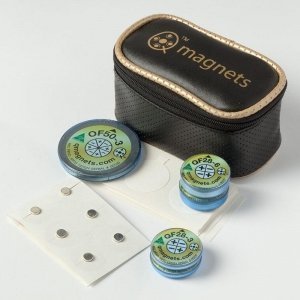
Q Magnets can be applied using sports tape such as Fixomull, Hyperfix, or Cover-Roll, double-sided adhesive patches such as QFix28, QFix6 plasters for smaller models, braces, elastic supports, bandages, headbands, or the Flux Attachment Plate for suitable clothing applications.
The key is to hold the magnet securely in the correct position. Q Magnets depend on accurate placement, and even a small shift may change the field exposure at the target area.
See How To Use Q Magnets.
For longer use, many people prefer a brace, wrap, elastic support, or clothing-based attachment method rather than repeated taping. For sport or movement, make sure the magnet cannot slip, detach, or attach unexpectedly to metal equipment.
Always apply the magnet with the correct side facing the body and the orientation arrow aligned as directed.
2. Since placement of Q Magnets is critical, how does one find the specific placement?
The simplest starting point is to place the Q Magnet over the area of tenderness. This may be suitable for local pain patterns such as a tender tendon, joint, muscle area, or minor localized injury.
However, placement is not always obvious. Pain may be referred from another area, influenced by nerve pathways, or related to spinal segments, acupressure points, or sensitized neural structures. In these cases, multiple Q Magnets may be used along relevant nerve pathways or related anatomical regions.
This is where Field | Dose | Placement becomes practical. The field must be appropriate for the target, the magnet size and exposure must match the depth and tissue, and the placement must be accurate enough to expose the intended area to the field gradient.
For example, a local sting or tennis elbow tenderness may respond best to direct placement over tender spots. A radiating nerve pattern may require placement closer to the relevant spinal level or nerve pathway. Acupressure-style placements may also be used in some protocols.
For most users, the Body Map is the best starting point because it gives recommended placements and magnet combinations. More complex pain syndromes may require guidance from a practitioner with knowledge of anatomy, neurology, physiotherapy, or acupuncture-style point selection.
3. Are there any contraindications of use?
Yes. The most important contraindication is that Q Magnets should not be used near pacemakers, implanted defibrillators, or other implanted electronic medical devices.
Extra caution is also needed around pregnancy, implanted medical hardware, magnetic storage media, aircraft instruments, and sensitive medical situations.
If you have a significant medical condition, implanted device, unexplained symptoms, or are unsure whether Q Magnets are appropriate for you, speak with a qualified health professional before use.
Q Magnets are designed to be low-friction wearable recovery tools, but they are still strong static magnets and should be treated with care.
Sports Featured Post