Temperomandibular Joint (TMJ) Pain Relief with Magnet Therapy

TMJ Pain is caused due to TMJ disorders and can be a constant pain accompanied by tenderness of your jaw. Magnet field therapy for TMJ pain can be potentially beneficial as it can assist in reducing pain. Let us learn about TMJ disorders and see how magnet therapy can be utilized for pain relief in TMJ joint.
What is TMJ and what are the causes of TMJ Pain?
The temporomandibular joint (TMJ) connects your jaw to the temporal bones of your skull, in front of the ears. It allows movement of your jaw, so you can chew, talk and yawn.

TMJ pain is caused by Temporomandibular Disorders or TMJ disorders associated with your joints and muscles of the jaw. It could arise as a result of jaw injury or stress as well as inflammatory conditions such as with arthritis where magnet therapy has been found to be beneficial.
TMJ pain can be mild but also often reach acute levels particularly while chewing. It is often accompanied by pain in the neck or shoulders, discomfort in opening the mouth wide, jaw locking, swelling and tiredness. If it doesn’t go away within a few days, it’s important to see a professional for diagnosis and treatment. Magnet therapy for TMJ to reduce pain is very simple to apply.
TMJ pain can also be caused due to a neurological condition known as Trigeminal Neuralgia. According to the American Association of Neurological Surgeons, Trigeminal Neuralgia is often described as the most excruciating pain known to man.
As per an article by the TMJ Association, other conditions can also cause TMJ Pain. So it’s not necessary that you have a TMJ disorder. These include Lyme disease, muscle inflammation, arthritis, ear ache, sinusitis and tooth ache among several others, where magnet therapy can often produce sufficient pain relief.
Most professionals such as dentists and MDs will take the usual route of diagnosis, pain relieving drugs or anti-inflammatories, tooth extraction and if that doesn’t help, then dive into surgery. However, these interventions do have a significant impact on your quality of life, therefore we believe that natural pain relief methods such as magnet therapy can be a useful complementary treatment to reduce TMJ pain. Let us now see how to apply magnet therapy for TMJ pain relief.
TMJ Pain Treatment Protocol
Your Pain >> Q Magnet Prescription for Trigeminal neuralgia:

Q Magnet devices can be placed over each temperomandibular joint (TMJ) which provides the best access to the trigeminal nerve. The TMJ can be identified by feeling in front of the ear with the index finger while opening and closing the mouth. A second device should also be placed over the occiput at the base of the skull which covers C1, see the head pain video for a description of the location of the occiput.
The devices should be worn at night and held in place by Q Magnet double-stick adhesives and /or tape. For more persistent pain, they can also be worn during the day. One way to attach the Q Magnet over the occiput, which is usually in the hair, is to insert it or attach it to a head band.
Download the Q Magnet trigeminal neuralgia PDF handout from presentations made at various TN support groups.
Some of the smaller trigeminal neuralgia support groups such as the Western Australian group have been open minded and actively seek out and investigate new drug free and non-invasive treatments in the interest of their members. Page three of the Western Australian support groups April 2011 Newsletter describes a number of their member’s experiences with Q Magnets, some of which were very encouraging. The following in an excerpt from page 1 of the December, 2011 Newsletter 192…
“…asked if there was any news on magnet therapy trials which led to a brief discussion on the subject.
Although we know that the research and the trials have not proven absolute success, it has been of some benefit to several members and is deemed worthy of a trial. As Julie Russell pointed out, medications also do not work for everybody and have side effects. Julie has experienced more pain relief with magnets than with medications.
Bevely and Julie have both found that the magnets help in minimising hyperactivity of the nerves.”
The Lifestyle Therapies chronic pain clinic in Brisbane puts out a Medico’s Newsletter and also describes two case studies of TN sufferers. See the Medico Newsletter here – A Novel and Effective Treatment for Trigeminal Neuralgia.
While some of the feedback from TN sufferers has been remarkable (see below), many Q Magnet customers have not had a complete cessation of pain but have been able to lower their medication. There are many forward thinking doctors who are willing to work with their patients with complementary (or non-drug) therapies to reduce medication. Hopefully you have, or can find such a doctor and they can assist you in monitoring your condition and symptoms while you use Q Magnet therapy. Use 1 or 2 magnets on each side for best results.
-

QF28-3
US$60.00 Add to cart45 MGOe (N45) Neodymium Rare Earth
Quadrapolar
Penetration = 48 mm / 1.92″
Magnet Width = 28 mm / 1.12″
Magnet Thickness = 3 mm / 0.12″
Pull Force = 206 N /21 kgf / 46 lbf
Flux Plate attached
Plastic casing -

QF20-2
US$33.00 Add to cart- 45 MGOe (N45) Neodymium Rare Earth
- Quadrapolar
- Penetration = 30 mm / 1.2″
- Magnet Width = 20 mm / 0.8″
- Magnet Thickness = 2 mm / 0.08″
- Pull Force = 90 N / 9 kgf / 20 lbf
- Flux Plate attached
- Plastic casing
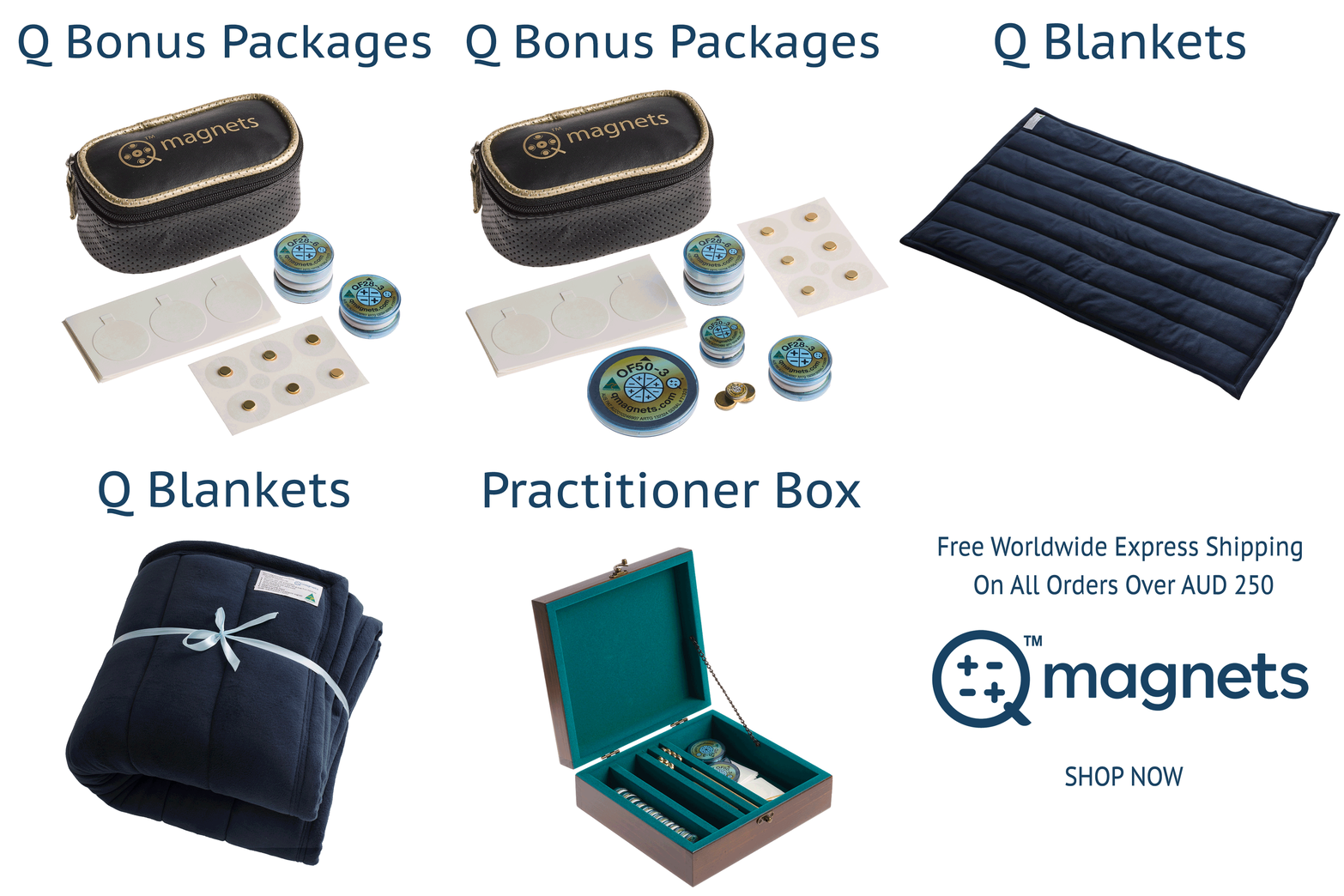
For best value order a Q Bonus Package
TRIGEMINAL NEURALGIA TESTIMONIES:
Lucretia Diplan is a retired doctor from Maryland in the US, this is her documented experience in using Q Magnets to treat her daughters MS-induced trigeminal neuralgia.
I ordered the magnets for my 45-year-old daughter who has been suffering from Multiple Sclerosis for 15 years. As part of the nerves demyelination process characteristic of this terrible autoimmune non-curable disease, she developed last year trigeminal neuralgia with excruciating pain firing along the mandibula.
The first placement did not work:
I applied first the two tiny magnets (MiniQ’s) along her jaw, one up next to the ear and the second on the spot where the pain is originating. She kept the magnets on her skin day and night for a full week with no relief whatsoever. For another 10 days she wore the two medium magnets on the same spots on her jaw as the first ones. No result, not even a slight alleviation. We are strong believers in the therapeutic action of magnetic fields. The neurologist who sees my daughter suggested we try therapeutic magnetic and he gave us your website where we ordered them. Unfortunately they did not work for my daughter although she was so hopeful that they will at least blunt the trigeminal neuralgia.
Physiotherapist and Clinical Educator for Q Magnets, Dianne Hermans suggested the following placements:
I have had two patients with this exact condition that the ProQ’s have worked wonderfully for them. You seem to have placed them in the right position, you will need to use the Pro’s for the best effect, the MiniQ’s will be too small for the job.
Place one over the temperomandibular joint which should be the main access to the trigeminal nerve.
One other placement I could suggest is to place one ProQ over the temperomandibular joint and the other at the base of the skull at the occiput over the basilar artery. You can use the MiniQ over the area where the pain originates, but the larger Pro’s should be used over the larger nerve structures.
You could even try moving the one over the TMJ around a little to see if you get a better effect. If they are in the right place and are going to work, the effects should be felt almost immediately or at the most a day. Don’t feel you have to leave them on for days at a time without changing the position.
Here was the response from Lucretia a few weeks later:
I have excellent news. After the original lack of response by using the two tiny magnets, we started on February 5 to use the big ProQ Magnets we placed on the TMJ and base of the skull, respectively, per Miss Dianne’s instructions. There have been two weeks since THE TRIGEMINAL PAIN SUBSIDED ALTOGETHER. The improvement was significant in the first 24 hours and subsequently receded gradually in a few days.
My daughter is currently pain-free after having suffered excruciating and constant pain for over a year.
She took off both magnets 3 days ago but, of course, keep them handy, just in case. Can you believe that not even strong opiates managed to alleviate the pain but for very short periods of time, and my daughter refused, for good reasons, to increase the dosage as she did not want to get dependent on them.
Now, for the first time in a year, my daughter was able to move her tongue in her mouth when speaking without triggering terrible pain along the jaw. Until then she was living on literally huge amounts of Orajel applied locally on the gums every 20 minutes, plus Oxicodon (she deliberately did not want to overuse to avoid dependency). She has not only been pain-free for a week now, but 2 days ago I removed the magnets from her skin to see if she can manage without them and SHE COULD. We keep the magnets in a special box and a safe place for future uses (hopefully not to be needed!!).
God bless you and grant you the best of everything.
This is the story as told by Bob Davies from Queensland, Australia.
I am a 47 yr old man who was diagnosed with MS IN 1994 [about 15 yrs ago] My MS is the secondary proggressive type so I dont experience regular exacerbations, just a steady decline. Although using a wheelchair for the last 10 years I still spend about 1 hr in the pool every day and try to keep as fit as possible.
About 2 yrs ago I started to experience severe pain shooting upwards from my upper RH row of teeth, so to the dentist I went, to be told, there is no dental reason for the pain. GP visit followed, where I was given painkillers & referred to a Neurologist. Meanwhile I had done as much research on TMJ pain on the net as I could and when the specialist suggested cutting the facial nerves I thought, there must be a better way.
Fortunately there was a physio at the same practice as my GP so I went to see him. He supported my suggestion of magnet therapy so I bought 2 of the 2nd largest magnets that Q Magnets supply [I lived less than 5 km from Dianne’s practice] and in fact, been there for physio on ankle previously]. I already had a splint to wear at night supplied by a dentist, and as soon as I began to wear the magnets taped over the TMJ joint I experienced immediate pain relief.
After 1 week of wearing the magnets 24/7 I was completely pain free. It was nearly 12 months before jaw pain returned.
Again I wore the magnets for 1 week or so again eliminating the pain. The TMJ pain seems to be related to MS episodes, but at least I know the jaw pain can be cured in 1 week or so with my Q Magnets. Thankyou Q Magnets……Bob
TMJ Pain Relief Testimonials
“Trigeminal Neuralgia pain is decreased!”
I have been using my Q magnets for about six weeks now and they have greatly helped to reduce my trigeminal neuralgia pain! I am so happy with how...

Experience with Q Magnets from Therapist of Natural Medicine
Dr. Antonio Ritto from Portugal is a highly acclaimed dentist, natural medicine clinician and master in neural therapy. He has several publications in Kinesiology Journals as well. We’re pleased to share his findings and methods of applying Q Magnets in this article.
Inhomogeneous static magnetic field effects on TMJ Pain
DISCLAIMER: The type of magnet used is this study is not a Q Magnet. The safety and effectiveness of Q Magnets has not been established in the...
-
 Q Bonus Package - General UseUS$214.00
 -
 Q Bonus Package - Complex Lower Back PainUS$394.00
 -
 Q Bonus Package - Lower Back PainUS$252.00
 -
 Q Bonus Package - Active AthleteUS$501.00
 -
 Q13 Blanket (Sm)US$544.00