These are individual experiences, not universal outcomes. Sports injuries and overuse problems may still require load management, behaviour change, rest, rehabilitation, or medical assessment depending on the cause.
For a broader overview of early application, correct use, and recovery principles, see Magnetic Therapy for Sports Injury Recovery
See also Magnetic Therapy page.
Australian Twenty20 cricket captain Shane Watson
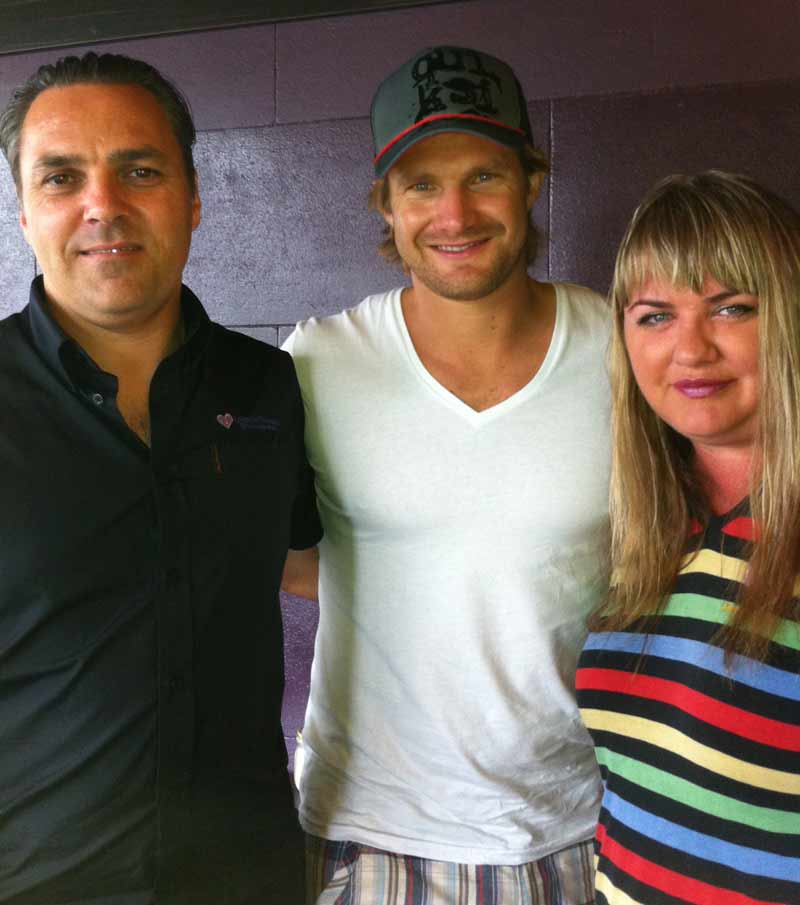
Shane Watson with Q Magnets inventors, James & Dianne Hermans
Shane Watson was looking for help with a persistent low back problem when he sought out a highly regarded therapist who recommended Q Magnets as part of his treatment plan. Shane later said they had “worked an absolute treat”.
Read Shane Watson’s full review For more examples, see testimonial case studies
AFL champion Simon Black

Australia Top Sports Physiotherapy Review by Simon Black
Veteran Brisbane Lions footballer Simon Black is one of the most decorated players in AFL history. Over a long elite career, he came to know what helped his body recover and what did not. Q Magnets became part of his recovery routine, and he spoke positively about the results he experienced while continuing the demands of top-level football.
Wallabies star David Pocock
David Pocock gave one of the simplest endorsements. After using Q Magnets, he posted that he was “really liking the magnets” and asked where he could order more, adding the hashtag #recoverfaster.
That kind of response is brief, but it says a lot. In elite rugby, players tend to keep using what fits into the realities of training, contact, recovery, and the need to stay ready week after week.
That kind of response is brief, but it says a lot. In elite rugby, players tend to keep using what fits into the realities of training, contact, recovery, and the need to stay ready week after week. This is perfectly illustrated by another former Wallaby’s player Adam Wallace-Harrison and former New Zealand All Black David Hill. (On this, we need to check if Adam did actually make the Wallaby’s team, otherwise will refer to him as former Queensland Reds player)
Also, this page has the following link included twice.
Magnetic Therapy for Sports Injury Recovery
Once at the top and another at the bottom with the old anchor text – and Recover Faster After Bruising, Haematoma and Soft-Tissue Injuries
@Neuromagnetics really liking the magnets… best place to order them? #recoverfaster
— David Pocock (@DavidPocock) March 10, 2012
@Neuromagnetics rulez….just adding to @pocockdavid magnetic personality with some non-medication management pic.twitter.com/zaw7m42S
— LITFL (@sandnsurf) March 3, 2012
Why these testimonials stand out
These athletes came to Q Magnets through recommendation by their medical team, experience, and practical use in demanding sporting environments. That is part of what makes their feedback meaningful. The pattern is not that every injury is the same. The pattern is that local pain relief and easier day-to-day management can matter when an athlete is trying to recover, train sensibly, and stay functional.
Beyond Australia
Beyond Australia, interest in Q Magnets can also be seen in elite international sport. USA Rugby Olympian Carlin Isles shared this response after using Q Magnets in his recovery setup: “Q Magnets are a great tool, man.”
You can see how his sports chiropractor applied Q Magnets directly into a forearm brace, making them easy to wear as part of an existing recovery routine.
Watch the Carlin Isles video clip.
See more sports recovery examples
For more examples of how Q Magnets have been used in sport, see Sports Recovery Testimonials and Recover Faster After Bruising, Haematoma and Soft-Tissue Injuries. For broader background on use, timing, and recovery principles, visit Magnetic Therapy for Sports Injury Recovery.
Frequently Asked Questions
How do Q Magnets work?
Q Magnets are designed to create localized static magnetic field gradients using multipolar magnet geometry. Unlike simple bipolar magnets, Q Magnets use alternating poles within one device to produce a more complex field pattern.
The proposed biological effect is not based simply on magnet strength. Instead, Q Magnets are positioned through Field | Dose | Placement: field, dose, and placement all need to work together.
Q Magnets should therefore be understood as precision field-based recovery tools rather than general-purpose magnets.
How do I know which Q Magnet to use?
Choosing the right Q Magnet depends on the target area, tissue depth, magnet size, polarity pattern, and placement goal. This is the practical role of Field | Dose | Placement: The field design, exposure dose, and anatomical placement all need to work together.
A useful way to learn the range is to review the Device Selection information and the Products page, especially the individual magnet descriptions, sizes, and penetration depth guidance. Strongest is not always best.
Since placement of Q Magnets is critical, how does one find the specific placement?
The simplest starting point is to place the Q Magnet over the area of tenderness. This may be suitable for local pain patterns such as a tender tendon, joint, muscle area, or minor localized injury.
However, placement is not always obvious. Pain may be referred from another area, influenced by nerve pathways, or related to spinal segments, acupressure points, or sensitized neural structures. In these cases, multiple Q Magnets may be used along relevant nerve pathways or related anatomical regions.
For most users, the Body Map is the best starting point because it gives recommended placements and magnet combinations. More complex pain syndromes may require guidance from a practitioner with knowledge of anatomy, neurology, physiotherapy, or acupuncture-style point selection.
Can anyone treat themselves?
Many people can apply Q Magnets themselves if they follow the instructions carefully. The Body Map, How to Use guidance, and device-specific information are designed to help users select and place magnets more accurately.
Simple, localized problems may be easier to self-manage. More complex pain syndromes, radiating pain, chronic pain, neurological symptoms, or unclear diagnoses are better assessed by a doctor, physiotherapist, or other qualified practitioner.
Do not use Q Magnets as a reason to delay care for a significant medical problem.
Are there any contraindications of use?
Yes. The most important contraindication is that Q Magnets should not be used near pacemakers, implanted defibrillators, or other implanted electronic medical devices.
Extra caution is also needed around pregnancy, implanted medical hardware, magnetic storage media, aircraft instruments, and sensitive medical situations. If you have a significant medical condition, implanted device, unexplained symptoms, or are unsure whether Q Magnets are appropriate for you, speak with a qualified health professional before use.