The Hidden Trade-Off in Common Pain Relief Strategies
Pain relief is often the first priority after injury, and Non-Steroidal Anti-inflammatory Drugs (NSAIDs) are widely used in sport. However, research has observed that while these may reduce pain, they may also influence tissue healing outcomes.
One study found that athletes using NSAIDs experienced:
- Tendon healing failure in some cases
- Reduced tensile strength
- Poorer collagen organisation

Magnetic field therapy has been studied for its potential role in tendon healing and tissue repair.
In addition, delayed fracture healing has been reported, alongside known side effects impacting the digestive system, liver, and kidneys
For athletes, this creates a dilemma: short-term pain relief may come at the cost of long-term tissue integrity.
What’s Happening Inside Injured Tissue
Following injury, the body enters a repair process involving:
- Inflammatory cells
- Blood vessel formation
- Collagen production
These processes are essential for restoring strength and function. Disruption or delay in these stages may contribute to prolonged recovery or increased vulnerability to re-injury.
Observations from imaging (see page 1) show reduced inflammatory cell presence and fibroblast activity at later healing stages, highlighting how tissue response evolves over time
Where Magnetic Fields May Fit into Recovery
Magnetic field therapy has been studied as a non-invasive approach that may influence biological processes involved in healing.
A 2012 study on tendon injury observed that exposure to a static magnetic field resulted in:
- Reduced inflammatory cell presence
- Increased blood vessel proliferation
- Enhanced collagen formation
After 30 days, the treated group demonstrated:
- Improved wound healing
- Better physical activity levels
- Ability to weight bear earlier than controls
While the devices used were not Q Magnets, the findings are consistent with broader observations across magnetic field therapy evidence.
Applying Q Magnets in an Athletic Recovery Context (FDP Framework)
Field
Q Magnets use a multipolar magnetic field structure designed to create a gradient across tissue. This may influence local biological activity where applied.
Dose
Magnet selection may depend on:
- Depth of the injury
- Size of the affected area
Larger or deeper injuries may require stronger or larger magnets.
Placement
Placement is typically:
- Directly over the injured area
- Integrated into braces or supports where needed
For example, magnets can be embedded into a brace for continuous positioning without adhesive tape, as demonstrated in athlete use cases
What Athletes Notice When Using Magnetic Therapy
Elite-Level Recovery Patterns
AFL champion Simon Black reported that Q Magnets were:
- “Integral” to his recovery routine
- Helpful in extending his playing career

Elite athletes have shared their experience using Q Magnets as part of recovery and pain management routines.
He also noted significantly reduced healing times and consistent results. You can explore more real-world athlete and customer outcomes in the testimonial case studies.
International Athlete Example
Olympic rugby player Carlin Isles demonstrated practical use by incorporating Q Magnets into a forearm brace, describing them simply as:
“Q Magnets are a great tool man”
These examples reflect real-world patterns where athletes integrate magnets into ongoing recovery routines.
A Relatable Moment: When You’re Pain-Free but Not Fully Recovered
One of the most challenging phases for athletes is when pain reduces but the tissue is not fully healed.

Soft tissue injuries such as bruising and calf trauma may need careful load management even after pain reduces.
This is often when:
- Training resumes too early
- Load increases too quickly
- Re-injury risk rises
Approaches that support both symptom relief and soft tissue injury recovery may help bridge this gap more effectively.
Limitations and What to Keep in Mind
While magnetic therapy shows promising observations:
- Results may vary between individuals
- Not all injuries respond the same way
- Evidence comes from a mix of animal studies, clinical observations, and athlete experiences
Magnetic therapy should be viewed as a supportive tool rather than a standalone solution. It is also important to understand magnetic therapy contraindications before use.
Next Steps for Athletes Looking to Recover Smarter
If you’re dealing with ongoing pain or returning from injury:
- Understand the stage of your injury
- Consider how your recovery strategy affects long-term tissue strength
- Explore non-invasive options that may support healing processes
- Apply tools like Q Magnets consistently and correctly
For deeper guidance, explore:
- Magnetic therapy for athletes
- How to use Q Magnets for specific injuries
- The Field | Dose | Placement framework
Athlete Recovery Checklist:
- Avoid relying solely on pain suppression
- Support tissue healing, not just symptoms
- Apply magnets directly over injured areas
- Use braces or supports for consistent placement
- Monitor progress before increasing training load
Frequently Asked Questions
1. Do Q Magnet devices mask pain?
Q Magnets are not intended to numb an area like a local anaesthetic. They do not work like lidocaine, opioid medication, or pain-relieving drugs that temporarily block or override pain perception.
Their proposed role is more closely related to nervous system modulation. Laboratory and theoretical work suggests that steep static magnetic field gradients may influence nerve excitability and membrane behaviour, especially where sensitized nerves are involved.
A Roth-proof way to explain this is: Q Magnets may help create a localized field environment that supports reversible neuromodulation. They are not designed to “switch nerves off” permanently or hide an injury that needs medical care.
If pain is severe, worsening, unexplained, or associated with injury, swelling, weakness, numbness, fever, or other concerning symptoms, seek appropriate medical advice.
2. How do Q Magnets work?
Q Magnets are designed to create localized static magnetic field gradients using multipolar magnet geometry. Unlike simple bipolar magnets, Q Magnets use alternating poles within one device to produce a more complex field pattern.
The proposed biological effect is not based simply on magnet strength. Instead, Q Magnets are positioned through Field | Dose | Placement:
Field: multipolar geometry and localized gradients.
Dose: magnet size, field strength, tissue depth, exposure time, and cumulative use.
Placement: accurate positioning over or near the relevant nerve, joint, soft tissue, acupressure point, or referral pathway.
Research and theoretical work suggest that steep static magnetic field gradients may influence neuronal membrane excitability and ion channel behaviour. This may help explain why correct placement and model selection are so important.
Q Magnets should therefore be understood as precision field-based recovery tools rather than general-purpose magnets.
3. How do I apply the Q Magnet device?
Q Magnets can be applied using sports tape such as Fixomull, Hyperfix, or Cover-Roll, double-sided adhesive patches such as QFix28, QFix6 plasters for smaller models, braces, elastic supports, bandages, headbands, or the Flux Attachment Plate for suitable clothing applications.
The key is to hold the magnet securely in the correct position. Q Magnets depend on accurate placement, and even a small shift may change the field exposure at the target area.
See How To Use Q Magnets.
For longer use, many people prefer a brace, wrap, elastic support, or clothing-based attachment method rather than repeated taping. For sport or movement, make sure the magnet cannot slip, detach, or attach unexpectedly to metal equipment.
Always apply the magnet with the correct side facing the body and the orientation arrow aligned as directed. How
4. How do I know which Q Magnet to use?
Choosing the right Q Magnet depends on the target area, tissue depth, magnet size, polarity pattern, and placement goal. This is the practical role of Field | Dose | Placement: the field design, exposure dose, and anatomical placement all need to work together.
Q Magnets come in different sizes, strengths, thicknesses, and polarity arrangements, including quadrupolar, hexapolar, octapolar, and other multipolar configurations. In general, smaller magnets are often used for more superficial or precise applications, while larger or thicker models may be used where deeper penetration or broader exposure is needed.
A useful way to learn the range is to review the Device Selection information and the Products page, especially the individual magnet descriptions, sizes, and penetration depth guidance. Strongest is not always best. The right magnet is the one whose field and dose best match the target tissue.
For first-time users, the Body Map on the How to Use Q Magnets page is often the easiest starting point. It provides recommended magnets, placements, and application protocols based on Q Magnets’ research, clinical experience, acupuncture principles, and physiotherapy reasoning.
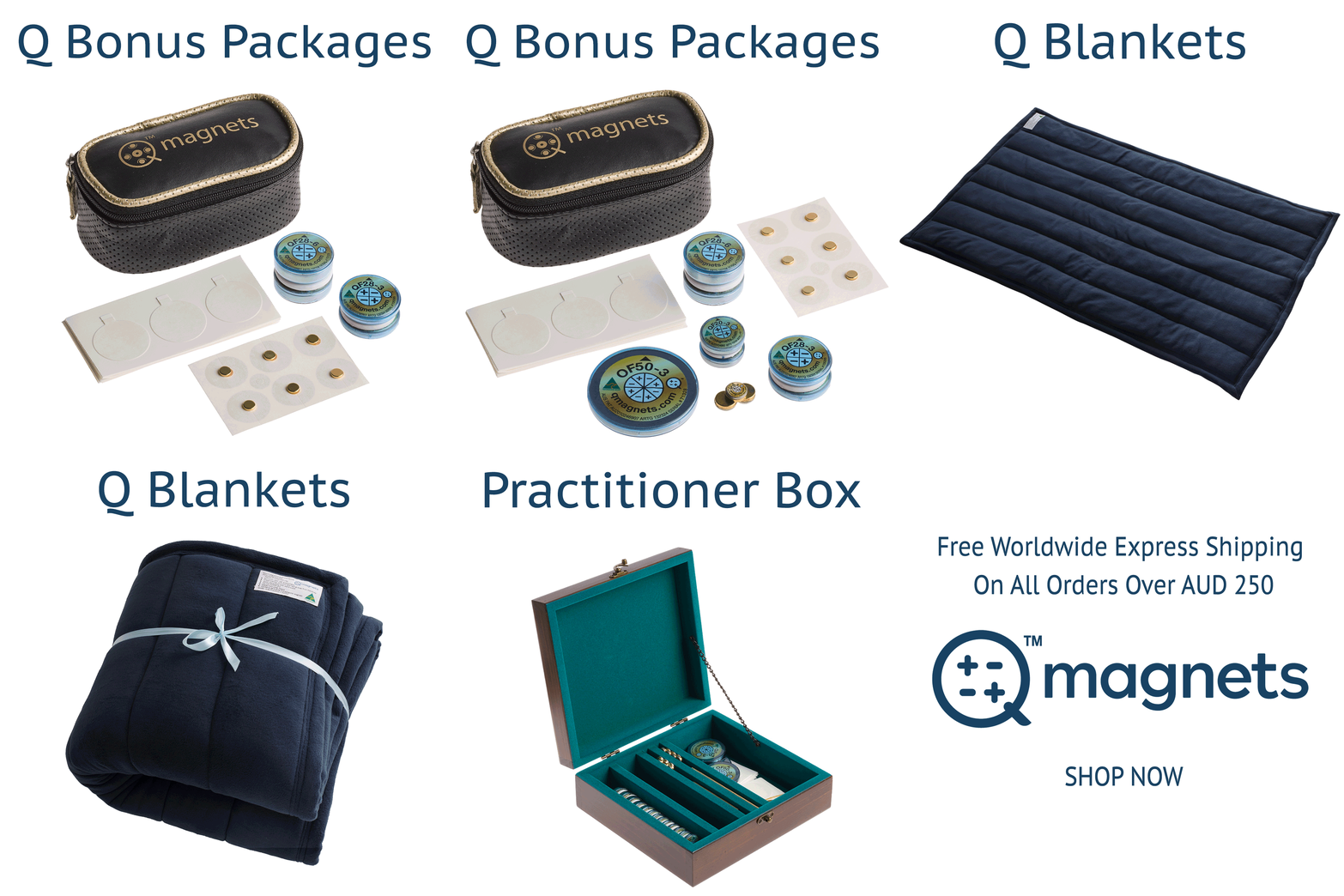
The Q Bonus Packages are also a practical first option because they include a variety of magnets suitable for small joints, large joints, and acupoint-style placements. Q Blankets may be a good choice for those looking for a comfortable sleep-time or rest-time static magnetic field environment, either as a throw-over blanket or used like a magnetic mattress pad.
5. Since placement of Q Magnets is critical, how does one find the specific placement?
The simplest starting point is to place the Q Magnet over the area of tenderness. This may be suitable for local pain patterns such as a tender tendon, joint, muscle area, or minor localized injury.
However, placement is not always obvious. Pain may be referred from another area, influenced by nerve pathways, or related to spinal segments, acupressure points, or sensitized neural structures. In these cases, multiple Q Magnets may be used along relevant nerve pathways or related anatomical regions.
This is where Field | Dose | Placement becomes practical. The field must be appropriate for the target, the magnet size and exposure must match the depth and tissue, and the placement must be accurate enough to expose the intended area to the field gradient.
For example, a local sting or tennis elbow tenderness may respond best to direct placement over tender spots. A radiating nerve pattern may require placement closer to the relevant spinal level or nerve pathway. Acupressure-style placements may also be used in some protocols.
For most users, the Body Map is the best starting point because it gives recommended placements and magnet combinations. More complex pain syndromes may require guidance from a practitioner with knowledge of anatomy, neurology, physiotherapy, or acupuncture-style point selection.