Most Q Magnets have a black orientation arrow (or triangle) just above the model number. When applying these magnets, the arrow should point along the body or limb towards the head.
This helps maintain consistent alignment of the magnet’s alternating pole boundaries with the intended anatomical region. The orientation rule does not apply to alternating-polarity concentric-ring Q Magnets.

Q Magnet showing orientation arrow.
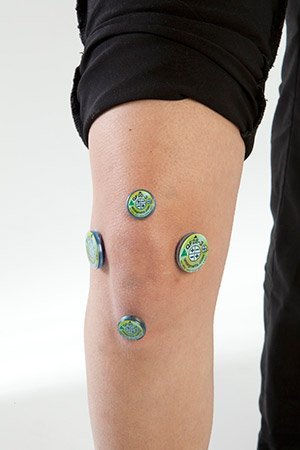
Knee pain example with arrows facing up.
Magnetic Viewing Film makes the alternating pole boundaries visible, showing how the orientation arrow aligns with a boundary. This can be seen in the hexapolar Q Magnet below.

Orientation arrow on Hexapolar magnet through magnetic viewing film
The same relationship can be seen in the quadrapolar Q Magnet below.
As explained on the device selection page, alternating magnetic poles create localised magnetic field gradients. These gradients are an important characteristic of Q Magnets’ multipolar design.

Orientation arrow on Quadrapolar Q Magnet.
Why Should the Orientation Arrow Point Towards the Head?
There are two main reasons for following the orientation arrow when applying Q Magnets:
- Alignment with the target anatomy. The alternating pole boundaries create regions of steep magnetic field gradients. Aligning the arrow towards the head provides a consistent orientation when positioning the magnet over nerves, many of which run lengthwise along the limbs towards the spine.
- Consistency when using multiple magnets. When two or more Q Magnets are positioned close together, their magnetic fields can interact and alter the resulting field distribution. Keeping the arrows aligned helps maintain consistent orientation. The current instructions also recommend separating magnets by approximately the width of the devices to minimise field interference.

Q Magnets for elbow pain showing the orientation arrow pointing along the limb up towards the head. The magnet is placed, in this case over the radial nerve so it passes along the centre of the magnet.
The alternating pole boundaries, sometimes referred to as the magnet’s sweet spots, are illustrated in red below.
Because magnetic fields are invisible, iron filings can help visualise their patterns. The filings align with the local magnetic field, illustrating how its direction varies around the alternating poles.
These illustrations help explain the magnet’s field geometry, although they do not establish that a particular boundary produces a specific physiological or clinical effect.

Iron filings showing direction of magnetic field lines over a Quadrapolar magnet. Red regions showing physiological active areas (sweet spot) of magnet.

Shoulder Placement showing orientation arrow pointing up, towards the head.

Q Magnet placement over ankle pain, showing the orientation arrow pointing up towards the head.