Case study from hockey ball strike posted on Q Magnets MagnaBlog.

Why athletes look for better recovery options
Athletes, especially those playing contact sports, do not just deal with pain. They deal with bruises, corks, impact injuries, minor sprains, strains, joint irritation, and the pressure to return to training before the tissue has fully settled.
Sometimes the injury is small but disruptive. A bruised finger, strained ankle, sore shin, or corked thigh may not be dramatic enough to stop life, but it can interfere with movement, confidence, sleep, and training rhythm. In other situations, a more substantial soft-tissue injury can make even simple movements feel guarded and uncomfortable.
What athletes usually want is not to switch an injury off completely. They want enough local relief to move better, complete rehab more comfortably, and keep training progressing sensibly while the tissue recovers. That matters because pain can become a limiting factor even when the tissue is ready for controlled loading. When local pain is reduced without taking away normal movement awareness, athletes may be able to rehab a muscle or tendon strain more confidently, tolerate slightly greater training intensity, and keep recovery moving in the right direction.
That is where recovery decisions matter. What gets done in the first hours after injury often shapes what the next few days look like.
Practitioner Insight: Why Gradient Fields Matter
Reference:
Man, D., et al. (1999). The influence of permanent magnetic field therapy on wound healing in suction lipectomy patients: a double-blind study. Plast Reconstr Surg Dec;104(7):2261-6. PMID: 11149796; doi.
Why Gradient Fields Matter
Q Magnets are best understood not as an energy-delivery device, but as a field-based therapy.
They create a persistent magnetic environment around the tissue, rather than delivering pulses, heat, or electrical input.
Field vs Energy: a different physical model
Q Magnets place tissue inside a static magnetic field with spatial variation.
This shifts the question from:
How much energy is being delivered?
to:
What environment are the cells operating within?
The role of field gradients
A key distinction is not just field strength, but how the field changes across space.
A more uniform magnetic field may have limited biological interaction.
A field gradient means the magnetic field changes across distance, and that is where the physics becomes more interesting.
Two relevant interactions
1. Moving charges in tissue
Ionic currents in nerves involve charged particles such as sodium and calcium ions moving through membrane channels and surrounding tissue.
This is commonly described by the Lorentz force:
F = q(v × B)
where:
- q = charge
- v = velocity of the ion
- B = magnetic field
This means moving ions in nerve tissue may experience very small forces in a magnetic field, with the potential to subtly influence signalling behaviour.
2. Magnetic dipoles in a gradient field
A second interaction becomes relevant when the field is non-uniform:
∇(m · B)
where:
- m = magnetic dipole moment
- B = magnetic field
In practical terms, a gradient field can exert forces on structures with magnetic properties at the microscopic level.
Why multipolar design matters
This is why multipolar magnetic design matters so much.
A simple magnet creates a relatively simple field.
Multipolar arrays such as quadrapolar, hexapolar, and octapolar designs create:
- rapid spatial variation
- steeper local gradients
- more complex field geometry
That matters because biological interaction is more likely in regions of high gradient than in regions where the field is more uniform.
Linking back to nerve function
Nerve signalling depends on ion flow, membrane excitability, and local electrical conditions.
A gradient-based field may subtly influence those conditions without shutting nerve conduction down or forcing activation.
That fits with the current view that pain-related signalling may shift while overall nerve function remains intact.
For athletes, that is highly relevant. Local pain relief may make a strained muscle or irritated tendon easier to move and load during rehab, while normal protective feedback is more likely to remain available. The aim is not to override the body’s warning system. The aim is to reduce unnecessary pain-limited guarding so that recovery and training progression can be managed more effectively.
Read more in Effects of Static Magnetic Fields on Nerve Conduction and Magnets vs Red Light, Infrared and TENS: What’s Actually Different From a Physics Perspective?
Why early application matters
After an injury, the body reacts quickly. Local tissues become irritated, inflammatory signals begin, blood vessels may dilate or leak, swelling can build, and pain signalling becomes more active. This early phase is not the whole story of recovery, but it is a very important part of it.
That is why early management has always been central to sports first aid.
Rest, ice, compression and elevation remain familiar elements of the older RICE approach. Q Magnets historically extended this to RICEM by adding magnets as an adjunct:
RICEM
- Rest
- Ice
- Compression
- Elevation
- Magnets
RICEM provides useful historical context, but sports injury management has increasingly shifted toward the more active PEACE & LOVE approach. Q Magnets may still be applied as soon as practical and positioned directly over the target tissue, but they should complement contemporary injury management and progressive rehabilitation rather than reinforce prolonged rest or routine icing.
From RICEM to PEACE & LOVE
RICEM remains useful for understanding how immediate sports injury care has traditionally been approached. However, many sports therapists now use the more contemporary PEACE & LOVE framework, which extends beyond short-term symptom management and supports a more active, progressive recovery process.
The established framework is:
PEACE – the early recovery phase
- P – Protect: Temporarily reduce movements and loads that aggravate the injury, while avoiding unnecessary prolonged rest.
- E – Elevate: Elevate the injured area where practical to help manage excessive swelling.
- A – Avoid unnecessary anti-inflammatory interventions: Inflammation is part of the normal repair response, so routinely suppressing it may not always support optimal tissue recovery.
- C – Compress: Use appropriate compression to help manage excessive swelling and provide support.
- E – Educate: Understand the injury, expected recovery time and importance of gradually returning to movement.
LOVE – the active rehabilitation phase
- L – Load: Gradually reintroduce appropriate movement and mechanical loading.
- O – Optimism: Maintain realistic confidence in the recovery process.
- V – Vascularisation: Introduce pain-free cardiovascular activity when appropriate.
- E – Exercise: Progressively restore mobility, strength, coordination and function.
PEACE & LOVE is the established sports injury recovery framework. At Q Magnets, we refer to our own adjunctive adaptation as PMEACE & LOVE, adding M for Magnets during the early recovery phase:
- P – Protect
- M – Magnets
- E – Elevate
- A – Avoid unnecessary anti-inflammatory interventions
- C – Compress
- E – Educate
M – Magnets
Q Magnets may be applied over the injured area as soon as practical, using the appropriate device size and accurate placement. Their role is adjunctive: they may help provide local comfort and support rehabilitation tolerance while the athlete continues appropriate protection, compression, education and professional care.
The addition of M for Magnets is specific to the Q Magnets adaptation. Magnets are not an official component of the established PEACE & LOVE framework, and they should not replace diagnosis, active rehabilitation or treatment recommended by a qualified health professional.

PMEACE & LOVE is Q Magnets’ adjunctive adaptation of the established PEACE & LOVE framework. Magnets are not part of the official PEACE & LOVE acronym.
After the early PMEACE phase, recovery should continue with LOVE – Load, Optimism, Vascularisation and Exercise – according to the injury, symptoms and professional guidance.
The original PEACE & LOVE framework spans immediate care and subsequent active rehabilitation, in contrast with older acronyms that concentrate mainly on acute management.
How magnetic therapy may help in sports injury recovery
The way magnetic therapy is often discussed in sport is more specific than many people realise.
It is not simply a question of putting any magnet anywhere and hoping for the best. Research and clinical discussion suggest that static magnetic fields may influence biological processes that are relevant to injury recovery, including pain signalling, ion-channel behaviour, inflammatory activity, and local vascular responses. That does not mean every injury responds the same way. It means there are plausible reasons why a correctly applied magnetic field may be useful in some recovery settings and less useful in others.
Practitioner Insight: Detailed mechanisms and explanation
One of the clearest practical ideas is that magnets may help in two overlapping ways.
The first is by helping calm pain pathways. Some people notice this fairly quickly when the device is placed over the right spot.
The second is by supporting the healing environment over time. Injured tissue still needs time to repair. Magnets do not make biology irrelevant. They may simply help create conditions that are more favourable while the body does the work of recovery.
Field | Dose | Placement
Results depend heavily on Field | Dose | Placement.
Field refers to the structure of the magnetic field. Q Magnets are designed around multipolar magnetic field gradients rather than a simple uniform field.
Dose means matching the device to the job. A small superficial joint may need a different device from a larger bruise or a deeper area of soft-tissue trauma. Surface area, tissue depth, and how long the device is worn all matter. See also Variations in Magnetic Field Therapy: What to Look For to Get It Right.
Placement means exactly that. The device needs to be placed over the relevant tissue, not vaguely nearby. If the field does not meaningfully reach the injured or irritated area, the result may be minimal.
For sports injuries, the practical questions are usually very simple:
- Was it applied early enough?
- Is it directly over the injured area?
- Is the device large enough for the tissue involved?
- Has it been worn for long enough to matter?
Specificity matters.
How Q Magnets are commonly used in practice
Across sports recovery, a consistent pattern appears.
Q Magnets are usually used:
- as soon as possible after injury
- directly over the point of impact or irritated tissue
- alongside PEACE & LOVE principles, appropriate professional care and progressive rehabilitation
- continuously during the active recovery period, where suitable and well tolerated
For many athletes, that simplicity is part of the appeal. Q Magnets can be taped in place, worn under clothing, integrated into braces, and left on while normal recovery strategies continue around them.
Published Research
The following published study evaluated the effectiveness of this type of therapy compared with placebo. The study took 20 patients who had just underwent liposuction surgery and gave 10 a coverage of ceramic magnets (not Q Magnets) and 10 the same looking cover with no magnets inside.
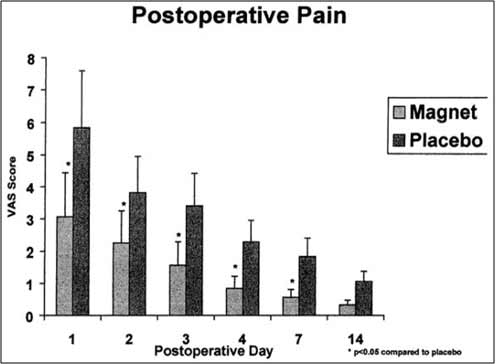
Post Operative Pain after active magnets as compared with placebo

Bruising and haematoma recovery example
The report stated… “In our group of study patients, magnetic field therapy was quite remarkable in both the prevention and treatment of these signs and symptoms and also in the alleviation of pain itself. The magnitude in the reduction of postoperative pain was quite significant, allowing for a decrease in the need for analgesic medication. In procedures in which significant ecchymoses or haematomas occur, one would normally expect manifestations such as these to take at least 2 to 3 weeks to resolve, whereas with the use of magnetic field therapy, they resolved in 48 to 72 hours, as is well demonstrated by the photographs.”
Sports injuries where this approach may be most relevant
Bruises, corks and haematomas
Heavy knocks are one of the clearest examples. They are local, often painful, and easy to identify early. Early placement, correct sizing, and continuous wear describe this clearly. A fresh bruise or cork is exactly the kind of injury where early placement, correct sizing, and continuous wear make practical sense. For more related examples, see the Bruises category and Q Magnets’ powerful effects on haematomas.
Minor sprains and small-joint injuries
A strained thumb, jammed finger, or bruised joint often responds best to precise placement. Smaller injuries do not always need a large device, but they do need accurate coverage. The key is not using more magnet than necessary. It is using the right device in the right place. See Q Magnet Therapy for Bruised Finger and QF10-2.
Muscle strains
Soft-tissue strains are another strong fit. These injuries often involve soreness, protective tension, local irritation, and a desire to keep the area settled while healing progresses. Early use, steady wear, and careful placement are recurring themes in athlete case material. See also Faster Recovery for Soft Tissue Injury Grade III Calf Tear.
Shin soreness and localised training injuries
Shin soreness is a good example of why precise application matters. In How to Use Q Magnet Therapy for Minor Shin Soreness, the emphasis is on placing the device directly over the injured tissue 24/7 during recovery and selecting a device with enough depth and surface area to envelop the target tissue.
Ligament recovery
More structured rehabilitation situations may also be relevant. In Enhancing ACL Recovery with Q Magnets, the focus shifts toward ligament healing biology, inflammation, collagen organisation, and recovery support over a longer timeframe.
What athletes and teams have reported
Athlete feedback does not replace research, but it does show how magnetic therapy is used in real sporting environments.
Simon Black described Q Magnets as part of his recovery routine and spoke positively about the results he experienced. Staff feedback from the Western Force highlighted the practical value of helping athletes settle injuries earlier in the week so they could return to training with better preparation. Carlin Isles showed another useful pattern: magnets integrated directly into a brace, making the treatment easy to wear continuously rather than something separate and inconvenient.

Simon Black and athlete recovery support with Q Magnets
Taken together, these examples point to a consistent pattern rather than a single dramatic claim. Athletes and practitioners who use Q Magnets most effectively tend to apply them early, place them directly over the target tissue, and use them alongside broader recovery routines.
How long should they be worn?
When Q Magnets are helping with an acute sports injury, they are usually worn continuously during the active recovery phase.
That may be a few days for a smaller injury or longer for a more substantial strain, bruise, or ligament problem. The point is to maintain the effect while the tissue settles. As symptoms improve, the magnets can be reduced or removed. If the area flares again, they can be reapplied.
This is one reason they are often described as having a subtle but sustained effect rather than a one-off dramatic burst.
Limitations
Magnetic therapy is not the right fit for every sports problem.
Practitioner Insight: Full limitations explanation
A practical way to think about it
The most useful question is not whether magnets work in the abstract.
The more useful question is whether a correctly applied magnetic field may help with this injury, in this tissue, applied at this time.
For a fresh sports injury, the practical process is straightforward:
- identify the injured area early
- apply the appropriate Q Magnet as soon as practical
- place it directly over the target tissue
- follow appropriate PMEACE & LOVE principles, including protection, compression, education and progressively guided movement
- continue with active rehabilitation and professional care where required
- reassess honestly as the tissue settles
That is where magnetic therapy makes the most sense in sport: as a simple, local, non-powered adjunct used early and used well.
Next steps
If you are dealing with a fresh sports injury, start with timing and placement. Apply the device early, match the size to the tissue involved, and keep the rest of your recovery plan in place.
For practical examples and condition-specific guidance, explore:
- PEACE & LOVE: A Modern Approach to Sports Injury Recovery
- RICEM and the importance of early application
- Does Magnetic Therapy Work?
- Applying Q Magnets to Thumb Sprains and Other Injuries
- How to Use Q Magnet Therapy for Minor Shin Soreness
- Enhancing ACL Recovery with Q Magnets
- Q Bonus Package Active Athlete
- Products
Frequently Asked Questions
1. How do Q Magnets work?
Q Magnets are designed to create localized static magnetic field gradients using multipolar magnet geometry. Unlike simple bipolar magnets, Q Magnets use alternating poles within one device to produce a more complex field pattern.
The proposed biological effect is not based simply on magnet strength. Instead, Q Magnets are positioned through Field | Dose | Placement:
Field refers to multipolar geometry and localized gradients.
Dose refers to magnet size, field strength, tissue depth, exposure time, and cumulative use.
Placement refers to accurate positioning over or near the relevant nerve, joint, soft tissue, acupressure point, or referral pathway.
Research and theoretical work suggest that steep static magnetic field gradients may influence neuronal membrane excitability and ion channel behaviour. This may help explain why correct placement and model selection are so important.
Q Magnets should therefore be understood as precision field-based recovery tools rather than general-purpose magnets.
2. How do I apply the Q Magnet device?
Q Magnets can be applied using sports tape such as Fixomull, Hyperfix, or Cover-Roll, double-sided adhesive patches such as QFix28, QFix6 plasters for smaller models, braces, elastic supports, bandages, headbands, or the Flux Attachment Plate for suitable clothing applications.
The key is to hold the magnet securely in the correct position. Q Magnets depend on accurate placement, and even a small shift may change the field exposure at the target area.
See How To Use Q Magnets.
For longer use, many people prefer a brace, wrap, elastic support, or clothing-based attachment method rather than repeated taping. For sport or movement, make sure the magnet cannot slip, detach, or attach unexpectedly to metal equipment.
Always apply the magnet with the correct side facing the body and the orientation arrow aligned as directed.
3. How do I know which Q Magnet to use?
Choosing the right Q Magnet depends on the target area, tissue depth, magnet size, polarity pattern, and placement goal. This is the practical role of Field | Dose | Placement: the field design, exposure dose, and anatomical placement all need to work together.
Q Magnets come in different sizes, strengths, thicknesses, and polarity arrangements, including quadrupolar, hexapolar, octapolar, and other multipolar configurations. In general, smaller magnets are often used for more superficial or precise applications, while larger or thicker models may be used where deeper penetration or broader exposure is needed.
A useful way to learn the range is to review the Device Selection information and the Products page, especially the individual magnet descriptions, sizes, and penetration depth guidance. Strongest is not always best. The right magnet is the one whose field and dose best match the target tissue.
For first-time users, the Body Map on the How to Use Q Magnets page is often the easiest starting point. It provides recommended magnets, placements, and application protocols based on Q Magnets’ research, clinical experience, acupuncture principles, and physiotherapy reasoning.
The Q Bonus Packages are also a practical first option because they include a variety of magnets suitable for small joints, large joints, and acupoint-style placements. Q Blankets may be a good choice for those looking for a comfortable sleep-time or rest-time static magnetic field environment, either as a throw-over blanket or used like a magnetic mattress pad.
4. Since placement of Q Magnets is critical, how does one find the specific placement?
The simplest starting point is to place the Q Magnet over the area of tenderness. This may be suitable for local pain patterns such as a tender tendon, joint, muscle area, or minor localized injury.
However, placement is not always obvious. Pain may be referred from another area, influenced by nerve pathways, or related to spinal segments, acupressure points, or sensitized neural structures. In these cases, multiple Q Magnets may be used along relevant nerve pathways or related anatomical regions.
This is where Field | Dose | Placement becomes practical. The field must be appropriate for the target, the magnet size and exposure must match the depth and tissue, and the placement must be accurate enough to expose the intended area to the field gradient.
For most users, the Body Map is the best starting point because it gives recommended placements and magnet combinations. More complex pain syndromes may require guidance from a practitioner with knowledge of anatomy, neurology, physiotherapy, or acupuncture-style point selection.
5. Do Q Magnet devices mask pain?
Q Magnets are not intended to numb an area like a local anaesthetic. They do not work like lidocaine, opioid medication, or pain-relieving drugs that temporarily block or override pain perception.
Their proposed role is more closely related to nervous system modulation. Laboratory and theoretical work suggests that steep static magnetic field gradients may influence nerve excitability and membrane behaviour, especially where sensitized nerves are involved.
A Roth-proof way to explain this is: Q Magnets may help create a localized field environment that supports reversible neuromodulation. They are not designed to “switch nerves off” permanently or hide an injury that needs medical care.
If pain is severe, worsening, unexplained, or associated with injury, swelling, weakness, numbness, fever, or other concerning symptoms, seek appropriate medical advice.