
What’s Actually Happening Inside a Hamstring Injury
The hamstring is made up of four muscles and five connecting tendons, running from the pelvis (ischial tuberosity) to the knee .
Strains can occur anywhere along this chain but are most common at the musculotendinous junction, where muscle meets tendon.
This explains why:
- Movement becomes painful
- Tissue thickening can often be felt
- Recovery requires both healing and gradual reloading
Understanding this structure is key to applying any recovery method effectively.
Where Q Magnetic Therapy Fits into Recovery
Q Magnets are positioned as an adjunctive therapy, meaning they are used in addition to prescribed treatment-not as a replacement .
Athlete feedback described in the source suggests:
- Less perceived pain
- A smoother recovery process
- Earlier return to sport or work activities
From a mechanism perspective, static magnetic fields are being explored for their potential influence on biological processes such as circulation and tissue response (how magnetic therapy works).
Importantly, outcomes may vary between individuals.
How Athletes Actually Apply Q Magnets (FDP Framework)
Field
Q Magnets use a quadrapolar magnetic field, designed to envelop the injured tissue area rather than act on a single point .
Dose (Device Size)
Selecting the correct size matters:
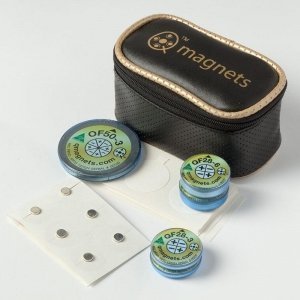
- QF28-3 → covers ~28mm (smaller strains)
- QF50-3 → covers ~50mm (larger injuries)
The goal is to ensure the entire injured region sits within the field.
Placement
- Locate the exact injury site (often painful with tissue thickening)
- Place the magnet directly over the strain
- Precise placement is critical for targeting the affected tissue.
Timing and Duration: What the Protocol Suggests
- When to start: As soon as possible after injury
- How long: Continuous use (24/7) throughout recovery
Additional notes from the protocol:
- Ice can be applied over the magnet
- Remove only during certain therapies (e.g. LLLT), then reapply immediately
- A potential synergistic effect has been observed when combined with other treatments
This reflects a sustained, low-level exposure approach, rather than short sessions.
The Reality for Athletes: “I Just Want to Get Back Out There”
One of the biggest frustrations with hamstring injuries isn’t just the pain-it’s the uncertainty.
- How long will it take?
- When can I sprint again?
- Will it happen again?
The source highlights that athletes using Q Magnets often report a smoother recovery experience, which may help reduce hesitation during rehab .
That psychological component-confidence in the muscle-is often just as important as physical healing.
What Evidence and Athlete Examples Show
Published Study (Animal Model)
A study on tendon injury found that magnetic field exposure was associated with:
- Reduced inflammatory cells
- Increased blood vessel growth
- Improved collagen formation
- Earlier weight-bearing
This suggests a potential biological response worth further investigation.
Athlete Case Example
In Australian Rules Football:
- Simon Black sustained a Grade I hamstring strain
- Applied Q Magnets immediately and continuously
- Returned within 7 days and delivered a best-on-ground performance
While individual cases don’t guarantee outcomes, they illustrate real-world application in elite sport.
(using Q Magnets to recover faster from hamstring tear)
Limitations and Important Considerations
- Q Magnets are not a replacement for medical care
- Recovery timelines still depend on injury severity
- Results may vary between athletes
- Proper diagnosis and rehab planning remain essential
Even when experiencing relief, the guidance is clear:
Continue your full rehabilitation program
What to Do Next if You’re Recovering from a Hamstring Strain
If you’re dealing with a hamstring injury:
- Get a clear diagnosis
- Follow a structured rehab plan
- Consider adjunct options like magnetic therapy
- Focus on gradual return to load and movement
For a deeper understanding:
Hamstring Strain Recovery with Q Magnets
Start: Immediately post-injury
Placement: Directly over tear site
Wear time: 24/7
Size: Match magnet to injury area
Use with: Ice, physio, rehab program
Goal: Support smoother recovery and earlier return to activity
Frequently Asked Questions
1. How do Q Magnets work?
Q Magnets are designed to create localized static magnetic field gradients using multipolar magnet geometry. Unlike simple bipolar magnets, Q Magnets use alternating poles within one device to produce a more complex field pattern.
The proposed biological effect is not based simply on magnet strength. Instead, Q Magnets are positioned through Field | Dose | Placement:
Field: multipolar geometry and localized gradients.
Dose: magnet size, field strength, tissue depth, exposure time, and cumulative use.
Placement: accurate positioning over or near the relevant nerve, joint, soft tissue, acupressure point, or referral pathway.
Research and theoretical work suggest that steep static magnetic field gradients may influence neuronal membrane excitability and ion channel behaviour. This may help explain why correct placement and model selection are so important.
Q Magnets should therefore be understood as precision field-based recovery tools rather than general-purpose magnets.
2. How do I apply the Q Magnet device?
Q Magnets can be applied using sports tape such as Fixomull, Hyperfix, or Cover-Roll, double-sided adhesive patches such as QFix28, QFix6 plasters for smaller models, braces, elastic supports, bandages, headbands, or the Flux Attachment Plate for suitable clothing applications.
The key is to hold the magnet securely in the correct position. Q Magnets depend on accurate placement, and even a small shift may change the field exposure at the target area.
See How To Use Q Magnets. For longer use, many people prefer a brace, wrap, elastic support, or clothing-based attachment method rather than repeated taping. For sport or movement, make sure the magnet cannot slip, detach, or attach unexpectedly to metal equipment.
Always apply the magnet with the correct side facing the body and the orientation arrow aligned as directed. How
3. How do I know which Q Magnet to use?
Choosing the right Q Magnet depends on the target area, tissue depth, magnet size, polarity pattern, and placement goal. This is the practical role of Field | Dose | Placement: The field design, exposure dose, and anatomical placement all need to work together.
Q Magnets come in different sizes, strengths, thicknesses, and polarity arrangements, including quadrupolar, hexapolar, octapolar, and other multipolar configurations. In general, smaller magnets are often used for more superficial or precise applications, while larger or thicker models may be used where deeper penetration or broader exposure is needed.
A useful way to learn the range is to review the Device Selection information and the Products page, especially the individual magnet descriptions, sizes, and penetration depth guidance. Strongest is not always best. The right magnet is the one whose field and dose best match the target tissue.
For first-time users, the Body Map on the How to Use Q Magnets page is often the easiest starting point. It provides recommended magnets, placements, and application protocols based on Q Magnets’ research, clinical experience, acupuncture principles, and physiotherapy reasoning.
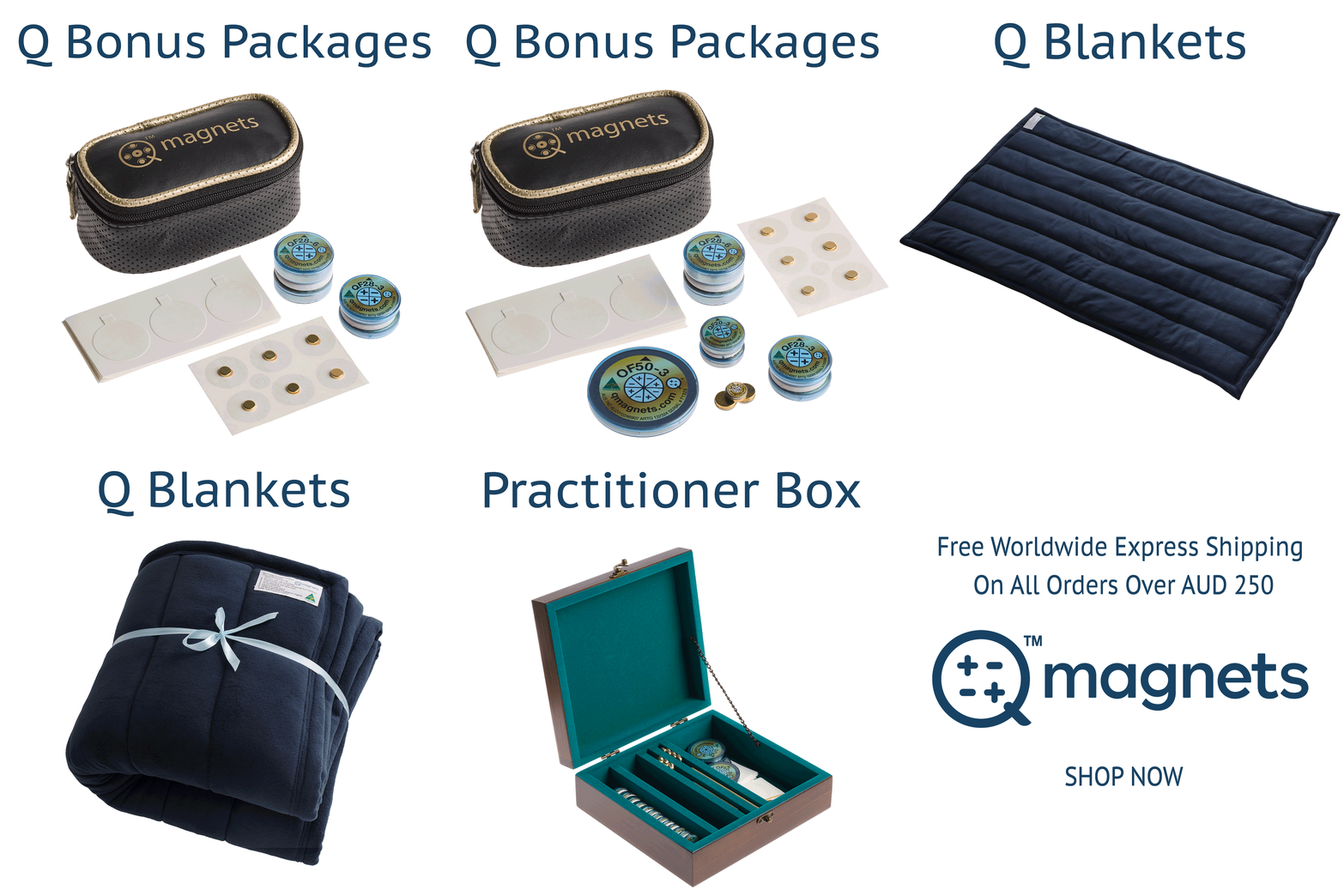
The Q Bonus Packages are also a practical first option because they include a variety of magnets suitable for small joints, large joints, and acupoint-style placements. Q Blankets may be a good choice for those looking for a comfortable sleep-time or rest-time static magnetic field environment, either as a throw-over blanket or used like a magnetic mattress pad.
4. Since placement of Q Magnets is critical, how does one find the specific placement?
The simplest starting point is to place the Q Magnet over the area of tenderness. This may be suitable for local pain patterns such as a tender tendon, joint, muscle area, or minor localized injury.
However, placement is not always obvious. Pain may be referred from another area, influenced by nerve pathways, or related to spinal segments, acupressure points, or sensitized neural structures. In these cases, multiple Q Magnets may be used along relevant nerve pathways or related anatomical regions.
This is where Field | Dose | Placement becomes practical. The field must be appropriate for the target, the magnet size and exposure must match the depth and tissue, and the placement must be accurate enough to expose the intended area to the field gradient.
For example, a local sting or tennis elbow tenderness may respond best to direct placement over tender spots. A radiating nerve pattern may require placement closer to the relevant spinal level or nerve pathway. Acupressure-style placements may also be used in some protocols.
For most users, the Body Map is the best starting point because it gives recommended placements and magnet combinations. More complex pain syndromes may require guidance from a practitioner with knowledge of anatomy, neurology, physiotherapy, or acupuncture-style point selection.
5. Do Q Magnet devices mask pain?
Q Magnets are not intended to numb an area like a local anaesthetic. They do not work like lidocaine, opioid medication, or pain-relieving drugs that temporarily block or override pain perception.
Their proposed role is more closely related to nervous system modulation. Laboratory and theoretical work suggests that steep static magnetic field gradients may influence nerve excitability and membrane behaviour, especially where sensitized nerves are involved.
A Roth-proof way to explain this is: Q Magnets may help create a localized field environment that supports reversible neuromodulation. They are not designed to “switch nerves off” permanently or hide an injury that needs medical care.
If pain is severe, worsening, unexplained, or associated with injury, swelling, weakness, numbness, fever, or other concerning symptoms, seek appropriate medical advice.
6. Are there any contraindications of use?
Yes. The most important contraindication is that Q Magnets should not be used near pacemakers, implanted defibrillators, or other implanted electronic medical devices.
Extra caution is also needed around pregnancy, implanted medical hardware, magnetic storage media, aircraft instruments, and sensitive medical situations. If you have a significant medical condition, implanted device, unexplained symptoms, or are unsure whether Q Magnets are appropriate for you, speak with a qualified health professional before use.
Q Magnets are designed to be low-friction wearable recovery tools, but they are still strong static magnets and should be treated with care.