Thursday late morning – bruised and swollen forefinger after football injury
When a Simple Finger Injury Disrupts Training
Finger injuries are often underestimated in sport. A sudden impact like catching a football awkwardly can cause immediate swelling and bruising, limiting grip and function.
In this case, a young boy injured his forefinger during football training:
“Swelled up almost immediately.”
By the following day, the finger was visibly bruised and movement was uncomfortable. A medical check confirmed there was no fracture, only a severe bruise.
For athletes, even minor joint injuries can interfere with training consistency, ball control, and confidence.
What’s Happening Inside a Bruised Finger
A bruised finger involves localised soft tissue trauma. This typically includes:
- Swelling due to fluid accumulation
- Discolouration from small blood vessel disruption
- Reduced mobility due to discomfort and pressure
These responses are part of the body’s natural recovery process. In small joints like fingers, the injury is:
- Highly localised
- Superficial (close to the skin)
- Sensitive to pressure and movement
Because of this, any intervention needs to be precise rather than excessive.
Applying Magnetic Therapy to a Finger Joint
Instead of using strapping or medication, a simple magnetic setup was applied.
As described in the case:
“I applied two small magnets either side of the middle knuckle, top and bottom.”
This placement is important. The magnets were positioned so that the magnetic field passed directly through the injured joint, rather than being placed loosely nearby.
For athletes managing minor joint injuries, this highlights a key principle:
precision matters more than intensity.
For comparison with larger injuries, see magnetic therapy for shin splints or managing muscle trauma in athletes.
Field | Dose | Placement in a Small Joint
This case is a clear example of the Field | Dose | Placement framework in action:
- Field: Multipolar static magnetic field
- Dose: Very small (suited to a small joint)
- Placement: One magnet on each side of the finger joint
A finger joint does not require a large magnetic field. In fact:
- Larger magnets are designed for deeper or broader injuries
- A small joint benefits from targeted, localised exposure
This distinction is critical in sports recovery. Using too much “dose” for a small injury may be unnecessary, while precise placement may better match the tissue involved.
For deeper understanding, see Field Dose Placement explained.
From Swelling to Normal Use in Just Days
The outcome was documented just a couple of days later.
“The other picture was taken on the Saturday morning showing all the bruising had gone and there was no pain.”

Saturday morning – bruising resolved, finger comfortable and functional
By Saturday morning:
- Swelling had subsided
- Bruising had cleared
- The finger was pain-free
- Normal function had returned
For an athlete, this meant a rapid return to normal hand use, an important factor in maintaining training continuity.
Why This Matters for Athletes Managing Minor Injuries
This example highlights a principle that applies broadly across sports recovery:
- Small injuries require precision, not power
- Application should match the size and depth of the tissue involved
In practical terms:
- A finger joint ≠ a hamstring or shin injury
- Recovery strategies should adapt accordingly
The case also reinforces that outcomes may vary depending on:
- Injury severity
- Timing of application
- Accuracy of placement
The Weekend You Don’t Want to Miss
For athletes, timing matters. Missing a weekend game or training session due to a minor injury can be frustrating.
In this case, the goal was simple:
help recovery happen quickly enough to return to normal activity.
This wasn’t a clinical trial or staged scenario. It was:
“A father trying to help his son recover in time for the weekend.”
That context is what makes the example relatable for athletes at all levels—from juniors to elite performers.
Limitations and Context
This is a single real-world observation, not a controlled study.
It suggests that:
- Magnetic field application may influence recovery outcomes
- Results can vary between individuals and injuries
Factors that may affect outcomes include:
- Injury type and severity
- Accuracy of placement
- Individual recovery response
Magnetic therapy should be viewed as a supportive approach, not a guaranteed solution.
What to Do Next
If you’re dealing with a similar minor sports injury:
- Confirm the injury is not structural (e.g., fracture)
- Focus on precise, localised application
- Match magnet size to the injury (small joint = small dose)
To explore practical setups and recovery strategies:
- See how to use Q magnets for sports injuries
- Learn more about targeted magnetic field placement techniques
- Read more real-world testimonial case studies
Injury Type: Bruised or sprained finger joint
Placement: One magnet on each side of the joint
Goal: Localised field through the injured tissue
Timing: Applied early after injury
Key Principle:
Precision placement is more important than magnet size
Frequently Asked Questions
1. How do I know which Q Magnet to use?
Choosing the right Q Magnet depends on the target area, tissue depth, magnet size, polarity pattern, and placement goal. This is the practical role of Field | Dose | Placement: The field design, exposure dose, and anatomical placement all need to work together.
Q Magnets come in different sizes, strengths, thicknesses, and polarity arrangements, including quadrupolar, hexapolar, octapolar, and other multipolar configurations. In general, smaller magnets are often used for more superficial or precise applications, while larger or thicker models may be used where deeper penetration or broader exposure is needed.
A useful way to learn the range is to review the Device Selection information and the Products page, especially the individual magnet descriptions, sizes, and penetration depth guidance. Strongest is not always best. The right magnet is the one whose field and dose best match the target tissue.
For first-time users, the Body Map on the How to Use Q Magnets page is often the easiest starting point. It provides recommended magnets, placements, and application protocols based on Q Magnets’ research, clinical experience, acupuncture principles, and physiotherapy reasoning.
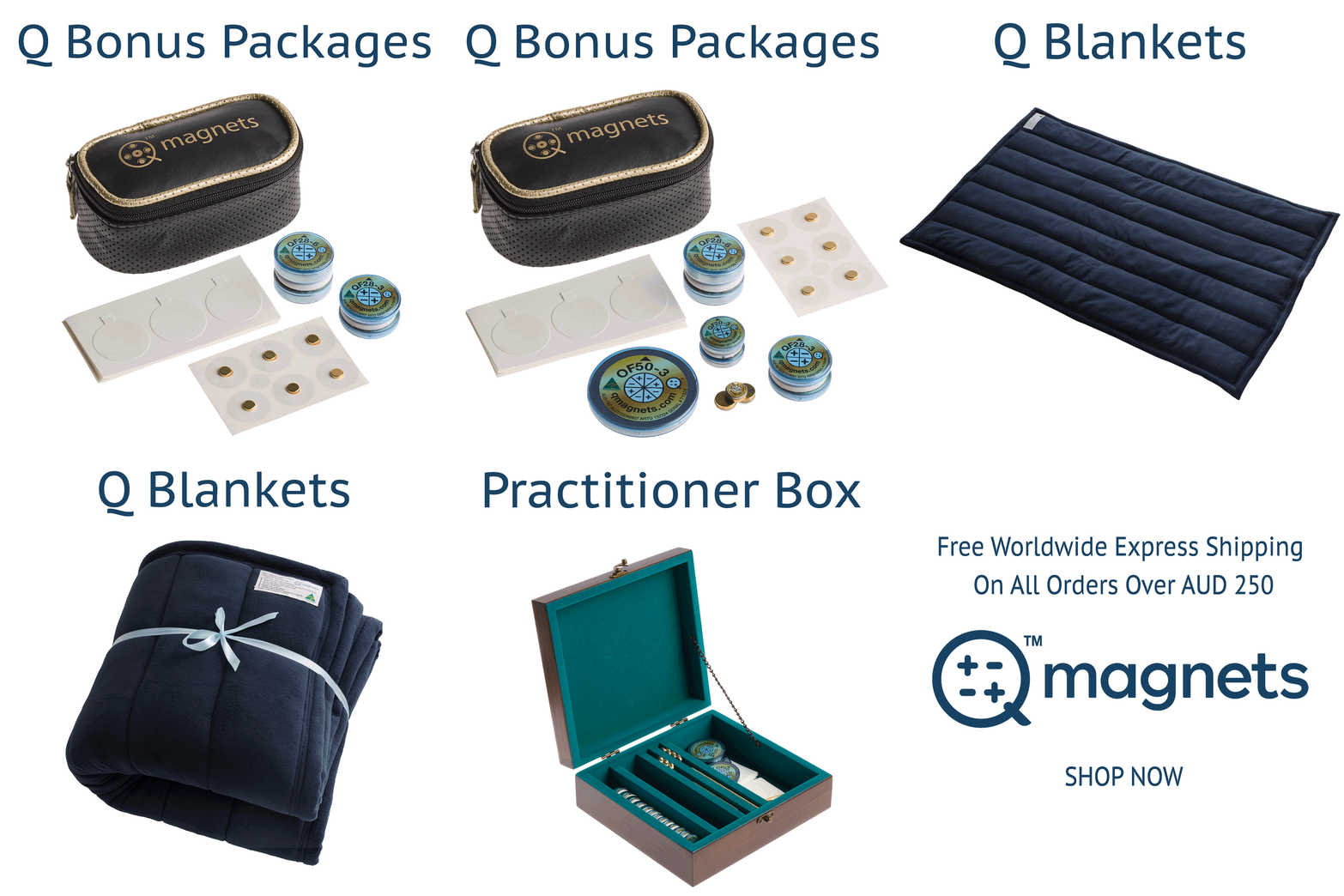
The Q Bonus Packages are also a practical first option because they include a variety of magnets suitable for small joints, large joints, and acupoint-style placements. Q Blankets may be a good choice for those looking for a comfortable sleep-time or rest-time static magnetic field environment, either as a throw-over blanket or used like a magnetic mattress pad.
2. Since placement of Q Magnets is critical, how does one find the specific placement?
The simplest starting point is to place the Q Magnet over the area of tenderness. This may be suitable for local pain patterns such as a tender tendon, joint, muscle area, or minor localized injury.
However, placement is not always obvious. Pain may be referred from another area, influenced by nerve pathways, or related to spinal segments, acupressure points, or sensitized neural structures. In these cases, multiple Q Magnets may be used along relevant nerve pathways or related anatomical regions.
This is where Field | Dose | Placement becomes practical. The field must be appropriate for the target, the magnet size and exposure must match the depth and tissue, and the placement must be accurate enough to expose the intended area to the field gradient.
For example, a local sting or tennis elbow tenderness may respond best to direct placement over tender spots. A radiating nerve pattern may require placement closer to the relevant spinal level or nerve pathway. Acupressure-style placements may also be used in some protocols.
For most users, the Body Map is the best starting point because it gives recommended placements and magnet combinations. More complex pain syndromes may require guidance from a practitioner with knowledge of anatomy, neurology, physiotherapy, or acupuncture-style point selection.