Understanding Sports Injury Recovery
Race car drivers operate under intense physical and mental pressure. Unlike many sports, they endure prolonged static positions combined with high G-forces, vibration, and repetitive strain.
This environment commonly leads to:
- Bruising from harness pressure
- Tendon-related strain
- Overuse issues such as shin soreness
These conditions can directly impact a driver’s ability to train consistently and perform at a high level. Recovery is not optional. It is essential for staying on the track.
What’s Happening in the Body
During racing and training, the body experiences continuous stress. Muscles fatigue from sustained tension, particularly in the core, neck, and lower limbs.
Over time, this leads to:
- Micro strain in muscles and tendons
- Inflammation in overused areas
- Reduced mobility and stiffness
- Delayed recovery between sessions
For drivers, even minor discomfort like shin soreness or lower back tightness can interfere with reaction time, endurance, and focus.
Why Athletes Are Using Q Magnets

Augusto Farfus and James Hermans at the GoldCoast600.

Dirk Mueller and James Hermans at the GoldCoast600.
In the motorsport environment, recovery solutions need to be practical, portable, and easy to use. This is where magnetic therapy with Q Magnets has gained traction among professional drivers.
At the GoldCoast 600, several European drivers were connected with Q Magnets, showing how widely adopted they have become across international racing circles.
Professional drivers such as Augusto Farfus incorporated Q Magnets into their routines after discovering their potential benefits. He initially tried smaller magnets during travel and later continued using them after further research and ordering a full set.
Other drivers, including Dirk Mueller, have also used Q Magnets to manage discomfort related to tendon strain and arm pain, reinforcing their relevance in real-world racing conditions.
These examples highlight a clear pattern: athletes are seeking tools that can support recovery while allowing them to maintain training intensity.
How Q Magnets May Help
Q Magnets are used by athletes as an adjunct therapy, meaning they are not a replacement for medical care but may support recovery efforts.
For race car drivers, they may help:
- Support recovery from muscle fatigue after racing
- Assist with managing soreness in areas like shins and lower back
- Provide a simple and self-managed option during travel and competition
- Encourage quicker return to training routines
Their appeal lies in their simplicity. They are easy to apply, require no downtime, and can be used alongside existing recovery strategies.
How to Use Q Magnets
Race car drivers typically apply Q Magnets directly to areas experiencing strain or fatigue.
Common placement areas include:
- Lower back for post-race stiffness
- Shins for overuse soreness
- Arms where tendon strain may occur
- Neck area for tension from prolonged driving posture
They are often used after training sessions or races, when recovery becomes the priority. Their portability makes them suitable for use during travel, in paddocks, or between sessions.
Apply Q Magnets immediately after racing or training to high-strain areas such as the lower back or shins to support recovery without disrupting your schedule.
Real-World Context
The presence of Q Magnets among professional drivers at events like the GoldCoast 600 reflects growing interest in recovery tools that fit the demands of elite sport.
Motorsport athletes operate in a unique environment where performance depends not only on skill but also on physical resilience.
Drivers such as Augusto Farfus, Dirk Mueller, and others have explored Q Magnets as part of their recovery approach, particularly for managing shin soreness, lower back pain, and tendon strain.
In a sport where even minor discomfort can affect performance, tools that may support faster recovery and consistent training are gaining attention.
Frequently Asked Questions
1. How do Q Magnets work?
Q Magnets are designed to create localized static magnetic field gradients using multipolar magnet geometry. Unlike simple bipolar magnets, Q Magnets use alternating poles within one device to produce a more complex field pattern.
The proposed biological effect is not based simply on magnet strength. Instead, Q Magnets are positioned through Field | Dose | Placement:
Field: multipolar geometry and localized gradients.
Dose: magnet size, field strength, tissue depth, exposure time, and cumulative use.
Placement: accurate positioning over or near the relevant nerve, joint, soft tissue, acupressure point, or referral pathway.
Research and theoretical work suggest that steep static magnetic field gradients may influence neuronal membrane excitability and ion channel behaviour. This may help explain why correct placement and model selection are so important.
Q Magnets should therefore be understood as precision field-based recovery tools rather than general-purpose magnets.
2. How do I apply the Q Magnet device?
Q Magnets can be applied using sports tape such as Fixomull, Hyperfix, or Cover-Roll, double-sided adhesive patches such as QFix28, QFix6 plasters for smaller models, braces, elastic supports, bandages, headbands, or the Flux Attachment Plate for suitable clothing applications.
The key is to hold the magnet securely in the correct position. Q Magnets depend on accurate placement, and even a small shift may change the field exposure at the target area.
See How To Use Q Magnets.
For longer use, many people prefer a brace, wrap, elastic support, or clothing-based attachment method rather than repeated taping. For sport or movement, make sure the magnet cannot slip, detach, or attach unexpectedly to metal equipment.
Always apply the magnet with the correct side facing the body and the orientation arrow aligned as directed.
3. How do I know which Q Magnet to use?
Choosing the right Q Magnet depends on the target area, tissue depth, magnet size, polarity pattern, and placement goal. This is the practical role of Field | Dose | Placement: The field design, exposure dose, and anatomical placement all need to work together.
Q Magnets come in different sizes, strengths, thicknesses, and polarity arrangements, including quadrupolar, hexapolar, octapolar, and other multipolar configurations. In general, smaller magnets are often used for more superficial or precise applications, while larger or thicker models may be used where deeper penetration or broader exposure is needed.
A useful way to learn the range is to review the Device Selection information and the Products page, especially the individual magnet descriptions, sizes, and penetration depth guidance. Strongest is not always best. The right magnet is the one whose field and dose best match the target tissue.
For first-time users, the Body Map on the How to Use Q Magnets page is often the easiest starting point. It provides recommended magnets, placements, and application protocols based on Q Magnets’ research, clinical experience, acupuncture principles, and physiotherapy reasoning.
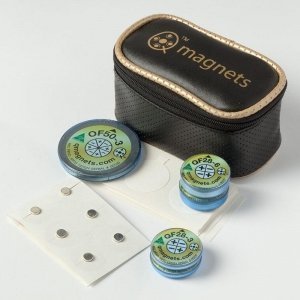
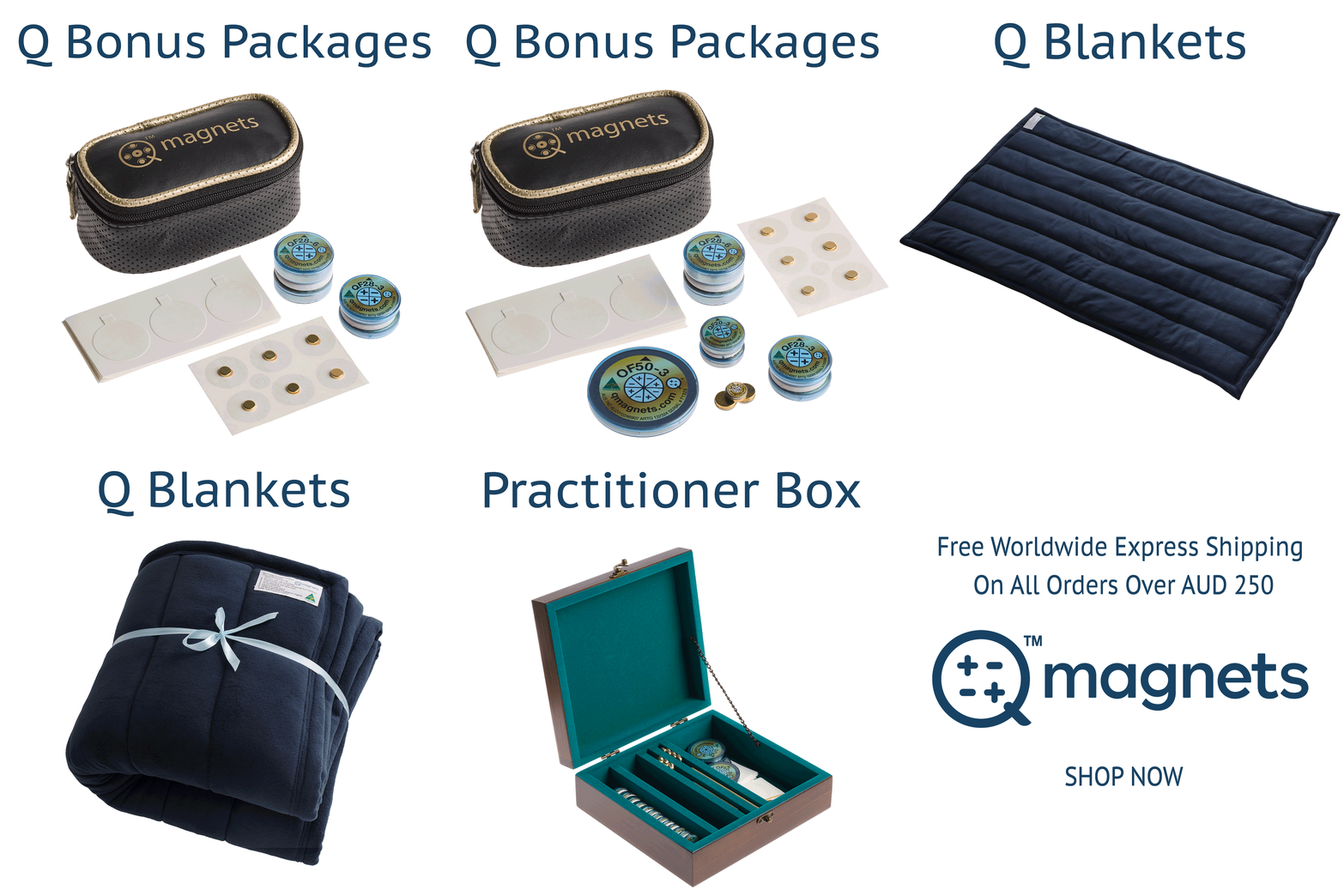
The Q Bonus Packages are also a practical first option because they include a variety of magnets suitable for small joints, large joints, and acupoint-style placements. Q Blankets may be a good choice for those looking for a comfortable sleep-time or rest-time static magnetic field environment, either as a throw-over blanket or used like a magnetic mattress pad.
4. Since placement of Q Magnets is critical, how does one find the specific placement?
The simplest starting point is to place the Q Magnet over the area of tenderness. This may be suitable for local pain patterns such as a tender tendon, joint, muscle area, or minor localized injury.
However, placement is not always obvious. Pain may be referred from another area, influenced by nerve pathways, or related to spinal segments, acupressure points, or sensitized neural structures. In these cases, multiple Q Magnets may be used along relevant nerve pathways or related anatomical regions.
This is where Field | Dose | Placement becomes practical. The field must be appropriate for the target, the magnet size and exposure must match the depth and tissue, and the placement must be accurate enough to expose the intended area to the field gradient.
For example, a local sting or tennis elbow tenderness may respond best to direct placement over tender spots. A radiating nerve pattern may require placement closer to the relevant spinal level or nerve pathway. Acupressure-style placements may also be used in some protocols.
For most users, the Body Map is the best starting point because it gives recommended placements and magnet combinations. More complex pain syndromes may require guidance from a practitioner with knowledge of anatomy, neurology, physiotherapy, or acupuncture-style point selection.