Understanding Sports Injury Recovery
In professional rugby, recovery is not optional. The physical demands of repeated collisions, sprinting, and load-bearing movements place constant stress on muscles and joints.
Athletes often deal with recurring issues such as calf strains, muscle tightness, and localized soreness. These are not one-off injuries but part of the ongoing cycle of training, competition, and recovery.
For players competing week to week, maintaining recovery momentum can influence not only performance and missed games, but also longevity in the sport.
What’s Happening in the Body
During intense rugby activity, muscle fibers experience micro-damage. This can lead to:
- Muscle fatigue from repeated high-intensity efforts
- Soft tissue strain from explosive movement and impact
- Localized inflammation and soreness after matches
When recovery is incomplete, these issues can accumulate. In Nick Kenny’s case, repeated calf strains became a limiting factor during his playing career.
Additionally, ongoing stress on the lower back can create tightness and reduced mobility, especially in athletes dealing with long-term structural challenges.
Learn how Q Magnets may help with back pain
Why Athletes Are Using Q Magnets
Nick Kenny’s experience stands out because of his dual role as both a professional athlete and a qualified physiotherapist.
He was introduced to Q Magnets during his rugby career while struggling with recurring calf injuries. After noticing changes in his recovery, he continued using them as part of his weekly routine.
Beyond personal use, he also observed how other athletes responded to Q Magnets in a clinical and team environment. This broader exposure reinforced their role as a complementary tool in sports rehabilitation.
In high-performance environments like the NRL, athletes are constantly exploring methods that may support faster recovery and better preparation between games.
Rugby Union players face a similar situation as illustrated by former Wallaby’s player Adam Wallace-Harrison and New Zealand All Black David Hill.
How Q Magnets May Help
Within an athlete recovery framework, Q Magnets may help support:
- Management of muscle tightness after training or matches
- Recovery from soft tissue issues such as strains and localized soreness
- Improved comfort during periods of high physical load
Nick Kenny noted improvements in movement and reduced discomfort when using magnets on areas like the lower back.
Importantly, Q Magnets are positioned as an adjunct therapy. They are used alongside structured rehab, strength work, and physiotherapy, not as a replacement. Readers wanting more background can explore how Q Magnets work and does magnetic therapy work.
How to Use Q Magnets
In high-contact sports, responding quickly after an injury is essential, with Q Magnets applied directly to the affected area at the earliest opportunity to support the body’s initial recovery response and help manage the immediate impact on soft tissue.
In a rugby recovery context, placement is typically focused on areas under consistent load:
- Calf muscles for strain-prone athletes
- Lower back for tightness and long-term stress
- Localized sore spots after impact or contact
Athletes may apply magnets after training sessions, during recovery periods, or as part of pre-game preparation. Consistency appears to be a key factor, especially when dealing with recurring soft tissue issues. Practical guidance is available in how to use Q Magnets.
For athletes dealing with strains, applying magnets immediately after an injury may help support the body’s natural recovery response. Early placement on the affected muscle can assist in managing discomfort and promoting a smoother recovery process.
Real-World Context
Nick Kenny’s experience carries weight due to his exposure to both elite sport and clinical practice.
He spent years in one of the toughest sporting environments and continued using Q Magnets throughout his career. Beyond personal use, he trialed them with other athletes, many of whom chose to adopt them into their own recovery routines.
This combination of firsthand use and professional observation explains why athletes and practitioners alike pay attention to his perspective. In high-performance sport, tools that fit into a broader recovery system often gain traction when they consistently support preparation and rehabilitation. For more technical context, see magnetic field gradients.
Testimonial Insight:
Frequently Asked Questions
1. How do Q Magnets work?
Q Magnets are designed to create localized static magnetic field gradients using multipolar magnet geometry. Unlike simple bipolar magnets, Q Magnets use alternating poles within one device to produce a more complex field pattern.
The proposed biological effect is not based simply on magnet strength. Instead, Q Magnets are positioned through Field | Dose | Placement:
Field: multipolar geometry and localized gradients.
Dose: magnet size, field strength, tissue depth, exposure time, and cumulative use.
Placement: accurate positioning over or near the relevant nerve, joint, soft tissue, acupressure point, or referral pathway.
Research and theoretical work suggest that steep static magnetic field gradients may influence neuronal membrane excitability and ion channel behaviour. This may help explain why correct placement and model selection are so important.
Q Magnets should therefore be understood as precision field-based recovery tools rather than general-purpose magnets.
2. How do I apply the Q Magnet device?
Q Magnets can be applied using sports tape such as Fixomull, Hyperfix, or Cover-Roll, double-sided adhesive patches such as QFix28, QFix6 plasters for smaller models, braces, elastic supports, bandages, headbands, or the Flux Attachment Plate for suitable clothing applications.
The key is to hold the magnet securely in the correct position. Q Magnets depend on accurate placement, and even a small shift may change the field exposure at the target area.
See How To Use Q Magnets.
For longer use, many people prefer a brace, wrap, elastic support, or clothing-based attachment method rather than repeated taping. For sport or movement, make sure the magnet cannot slip, detach, or attach unexpectedly to metal equipment.
Always apply the magnet with the correct side facing the body and the orientation arrow aligned as directed.
3. How do I know which Q Magnet to use?
Choosing the right Q Magnet depends on the target area, tissue depth, magnet size, polarity pattern, and placement goal. This is the practical role of Field | Dose | Placement: the field design, exposure dose, and anatomical placement all need to work together.
Q Magnets come in different sizes, strengths, thicknesses, and polarity arrangements, including quadrupolar, hexapolar, octapolar, and other multipolar configurations. In general, smaller magnets are often used for more superficial or precise applications, while larger or thicker models may be used where deeper penetration or broader exposure is needed.
A useful way to learn the range is to review the Device Selection information and the Products page, especially the individual magnet descriptions, sizes, and penetration depth guidance. Strongest is not always best. The right magnet is the one whose field and dose best match the target tissue.
For first-time users, the Body Map on the How to Use Q Magnets page is often the easiest starting point. It provides recommended magnets, placements, and application protocols based on Q Magnets’ research, clinical experience, acupuncture principles, and physiotherapy reasoning.
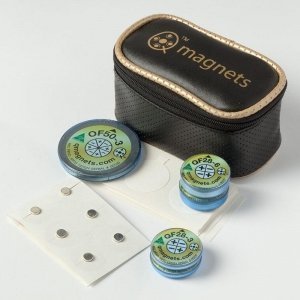
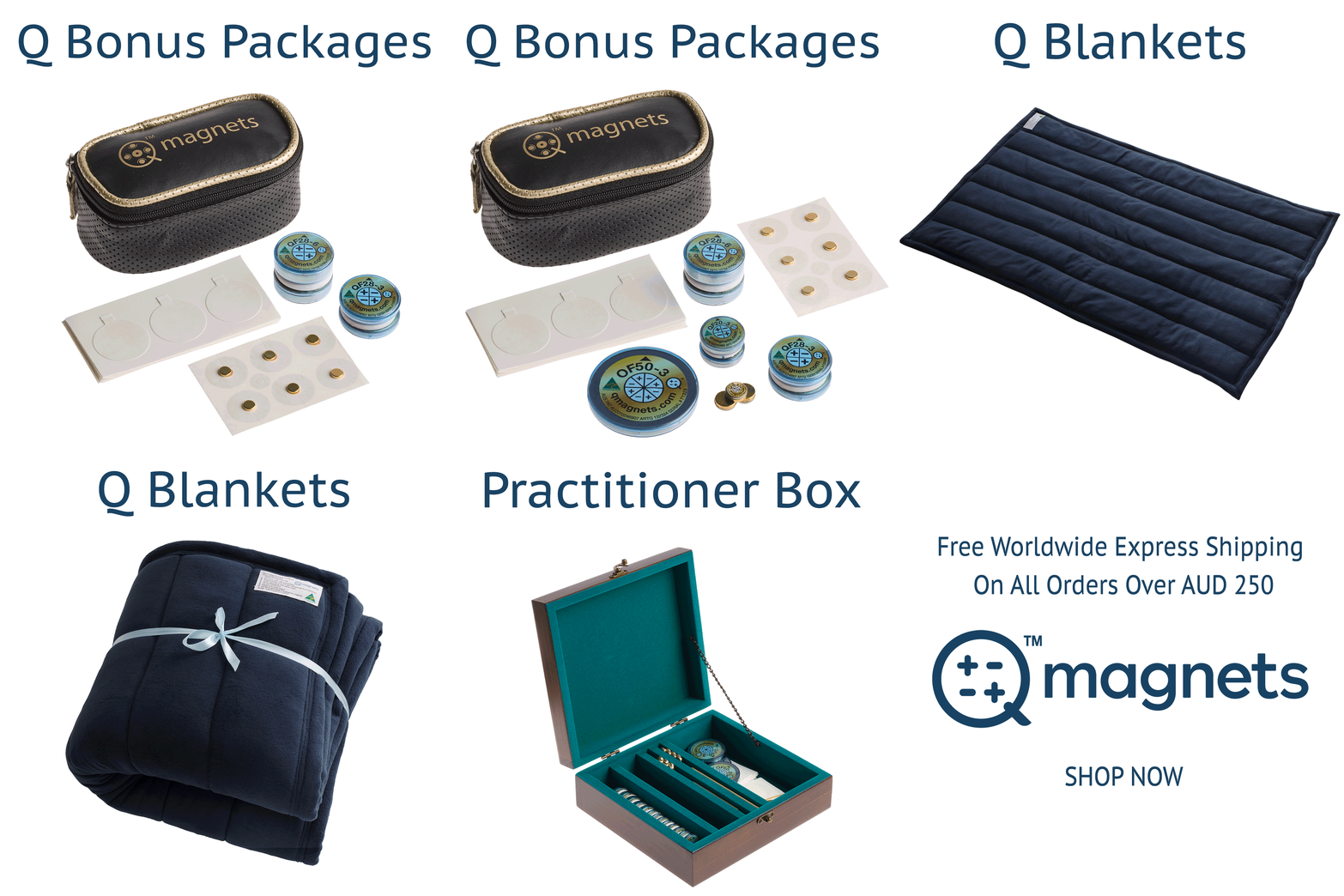
The Q Bonus Packages are also a practical first option because they include a variety of magnets suitable for small joints, large joints, and acupoint-style placements. Q Blankets may be a good choice for those looking for a comfortable sleep-time or rest-time static magnetic field environment, either as a throw-over blanket or used like a magnetic mattress pad.
4. Since placement of Q Magnets is critical, how does one find the specific placement?
The simplest starting point is to place the Q Magnet over the area of tenderness. This may be suitable for local pain patterns such as a tender tendon, joint, muscle area, or minor localized injury.
However, placement is not always obvious. Pain may be referred from another area, influenced by nerve pathways, or related to spinal segments, acupressure points, or sensitized neural structures. In these cases, multiple Q Magnets may be used along relevant nerve pathways or related anatomical regions.
This is where Field | Dose | Placement becomes practical. The field must be appropriate for the target, the magnet size and exposure must match the depth and tissue, and the placement must be accurate enough to expose the intended area to the field gradient.
For example, a local sting or tennis elbow tenderness may respond best to direct placement over tender spots. A radiating nerve pattern may require placement closer to the relevant spinal level or nerve pathway. Acupressure-style placements may also be used in some protocols.
For most users, the Body Map is the best starting point because it gives recommended placements and magnet combinations. More complex pain syndromes may require guidance from a practitioner with knowledge of anatomy, neurology, physiotherapy, or acupuncture-style point selection.