Case context
Pistol shooting forearm pain is often very local, aggravated by grip pressure, and difficult to settle once training resumes. This Q Magnets testimony sits within the context of magnetic therapy for sports injury recovery and how Q Magnets work. The purpose is to document one verifiable case of a shooter with localised forearm pain who reported a strong response to precise Q Magnet placement.
The problem
Condition description
Dean Mineall, an up-and-coming pistol shooter from the Gold Coast in Queensland, Australia, developed an overuse strain involving the extensor carpi radialis muscle on the back of the forearm. The pain was very specific and became worse when his thumb gripped the pistol.
Functional impact
The condition continued for months and became uncomfortable to the point that even holding a cup was difficult. In shooting sports, pain may be small in area but highly disruptive in practice.
Prior approaches
Before Q Magnets, several therapies were used, including trigger point therapy, laser therapy, soft tissue mobilisation, and dry needling. These approaches helped initially, but the pain returned when training resumed. This indicates the issue was not a casual ache that disappeared on its own, but an ongoing overuse problem that returned under load.
Application rationale
This case was relevant because the pain appeared to come from a very localised point on the forearm. When pain is specific, precise placement tends to matter more than broad coverage. Dean used a QF20-2 and placed it directly over the painful area. In Q Magnets terms, this aligns with field, dose, and placement:
Field: a structured static magnetic field
Dose: using a device size appropriate for the area involved
Placement: positioning directly over the target tissue.
In this context, the aim is not to make claims, but to note that a correctly placed device may influence pain signalling and local tissue responses in some situations, particularly where irritation is highly localised.
Reported experience
Initial response
Dean reported noticeable improvement within half an hour. At shooting practice, he reported approximately 60% improvement, and by the end of the night reported no pain.
Follow-up
The Q Magnet was left in place continuously for three days. Six months later, the pain had not returned, even though training volume had increased.
Testimonial statement
Interpretation
- the pain was clearly localised
- the magnet was placed directly over the painful site
- the device was worn continuously
- the result was assessed during return to training
At the same time, this remains one testimony, not a universal outcome. Overuse problems may still involve load management, behaviour change, rest, or rehabilitation. Not every case of arm pain will have the same cause or response, but in this case there was no rest or modification of behaviour at the time of the therapy. See limitations of Q Magnet therapy page for more details.
See also:
- When Pain Is A Signal Worth Listening To
- Red Flags: When Pain is a Warning, Not Just a Symptom
- Magnetic Field Therapy
For pistol shooting forearm pain, this case suggests consideration of Q Magnets when pain is specific, easy to locate, and aggravated by repetitive grip load. In these situations, precise placement and adequate wear time may be more relevant than brief or inconsistent use.
Frequently Asked Questions
1. Since placement of Q Magnets is critical, how does one find the specific placement?
The simplest starting point is to place the Q Magnet over the area of tenderness. This may be suitable for local pain patterns such as a tender tendon, joint, muscle area, or minor localized injury.
However, placement is not always obvious. Pain may be referred from another area, influenced by nerve pathways, or related to spinal segments, acupressure points, or sensitized neural structures. In these cases, multiple Q Magnets may be used along relevant nerve pathways or related anatomical regions.
This is where Field | Dose | Placement becomes practical. The field must be appropriate for the target, the magnet size and exposure must match the depth and tissue, and the placement must be accurate enough to expose the intended area to the field gradient.
For example, a local sting or tennis elbow tenderness may respond best to direct placement over tender spots. A radiating nerve pattern may require placement closer to the relevant spinal level or nerve pathway. Acupressure-style placements may also be used in some protocols.
For most users, the Body Map is the best starting point because it gives recommended placements and magnet combinations. More complex pain syndromes may require guidance from a practitioner with knowledge of anatomy, neurology, physiotherapy, or acupuncture-style point selection.
2. How do I know which Q Magnet to use?
Choosing the right Q Magnet depends on the target area, tissue depth, magnet size, polarity pattern, and placement goal. This is the practical role of Field | Dose | Placement: The field design, exposure dose, and anatomical placement all need to work together.
Q Magnets come in different sizes, strengths, thicknesses, and polarity arrangements, including quadrupolar, hexapolar, octapolar, and other multipolar configurations. In general, smaller magnets are often used for more superficial or precise applications, while larger or thicker models may be used where deeper penetration or broader exposure is needed.
A useful way to learn the range is to review the Device Selection information and the Products page, especially the individual magnet descriptions, sizes, and penetration depth guidance. Strongest is not always best. The right magnet is the one whose field and dose best match the target tissue.
For first-time users, the Body Map on the How to Use Q Magnets page is often the easiest starting point. It provides recommended magnets, placements, and application protocols based on Q Magnets’ research, clinical experience, acupuncture principles, and physiotherapy reasoning.
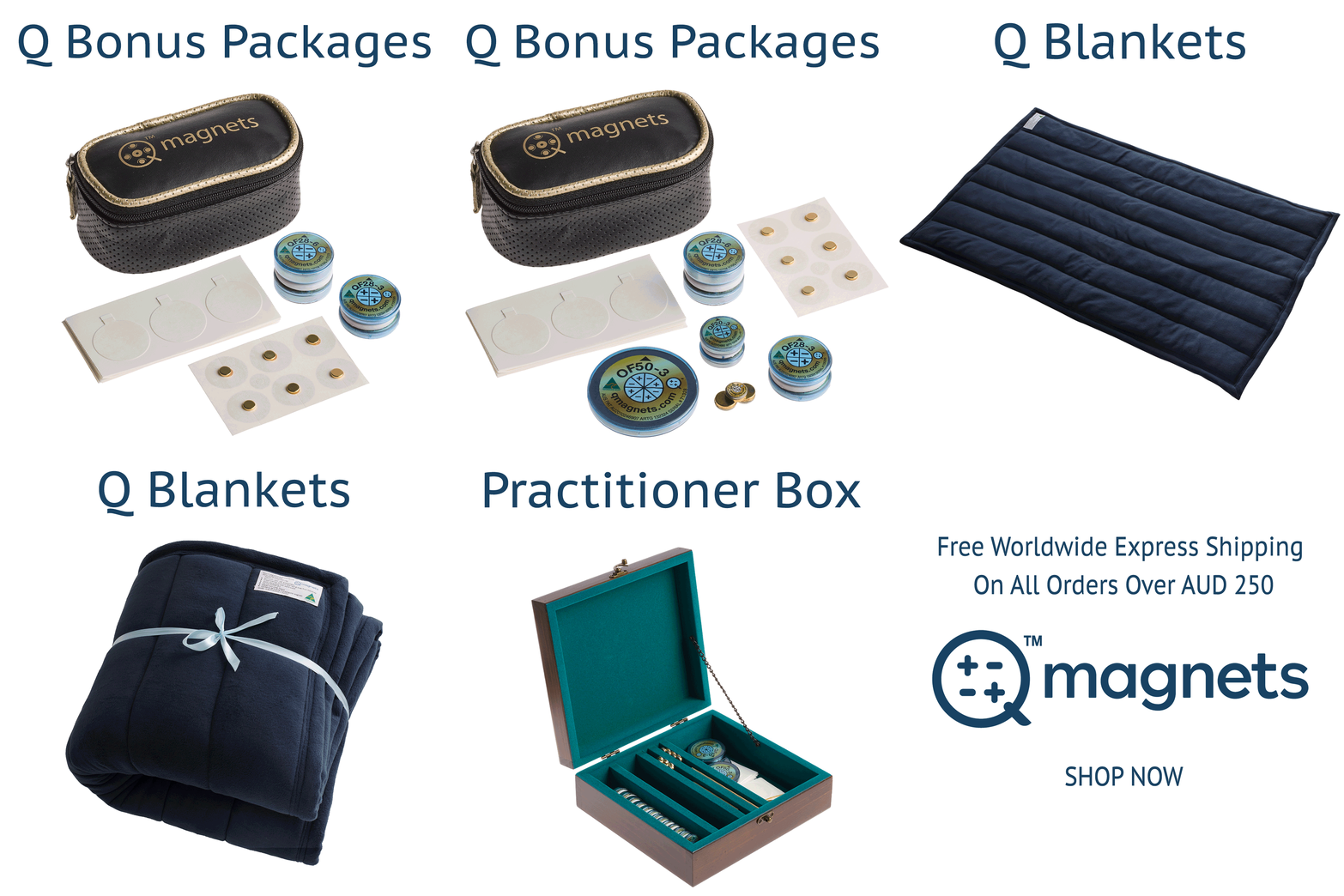
The Q Bonus Packages are also a practical first option because they include a variety of magnets suitable for small joints, large joints, and acupoint-style placements. Q Blankets may be a good choice for those looking for a comfortable sleep-time or rest-time static magnetic field environment, either as a throw-over blanket or used like a magnetic mattress pad.
3. How do Q Magnets work?
Q Magnets are designed to create localized static magnetic field gradients using multipolar magnet geometry. Unlike simple bipolar magnets, Q Magnets use alternating poles within one device to produce a more complex field pattern.
The proposed biological effect is not based simply on magnet strength. Instead, Q Magnets are positioned through Field | Dose | Placement:
Field: multipolar geometry and localized gradients.
Dose: magnet size, field strength, tissue depth, exposure time, and cumulative use.
Placement: accurate positioning over or near the relevant nerve, joint, soft tissue, acupressure point, or referral pathway.
Research and theoretical work suggest that steep static magnetic field gradients may influence neuronal membrane excitability and ion channel behaviour. This may help explain why correct placement and model selection are so important.
Q Magnets should therefore be understood as precision field-based recovery tools rather than general-purpose magnets.