- Comfort.
- Mobility.
- Independence.
For the daughter of Johanna Keysers, seeing her 93-year-old mother continue to enjoy those things has been incredibly important. Over the years, her mother has faced significant health challenges, including severe peripheral artery disease in her legs and a fractured vertebra following a fall. Yet despite these difficulties, she continues to maintain a level of comfort and mobility that has allowed her to stay active and remain out of aged care. One small part of that daily routine has been the consistent use of a Q Magnet Blanket.

A Q Magnet Blanket That Became Part of Everyday Life
According to Johanna’s daughter, her mother has been sleeping with a small Q Magnet Blanket for years.
When speaking with her vascular specialist, one question comes up repeatedly: does she experience pain in her legs when walking?
Johanna’s answer is simple.
“No pain.”
While every person’s experience is unique, Johanna believes the blanket has played an important role in her ongoing comfort and wellbeing.
Like many long-term Q Magnet users, Johanna didn’t adopt the blanket as part of a short-term recovery plan. Instead, it became a consistent part of her nightly routine, much like a favourite pillow or comfortable mattress.
Over time, those small daily habits can become the foundation of a better quality of life.
Supporting Comfort During the Later Years of Life
One of the themes we hear regularly from customers is that comfort becomes increasingly valuable with age.
For Johanna, maintaining comfort has meant being able to continue moving, walking, and enjoying greater independence despite her health challenges.
The Q Magnet Blanket offers a simple, passive way to incorporate static field therapy into everyday life. Unlike recovery tools that require appointments, charging, or scheduled sessions, the blanket can be used while resting or sleeping.
Many customers appreciate this low-effort approach, particularly older adults who may benefit from consistent overnight use as part of a broader wellness routine. This aligns with Q Magnets’ philosophy of creating wearable recovery environments that fit naturally into daily life.
More Than One Q Magnets Product in the Toolbox
Johanna’s daughter also shared that her mother uses a OF50-3 magnet on her lower back.
After suffering a fall and fracturing a vertebra, she experienced ongoing discomfort in an already compromised lower back. According to Johanna, the magnet became a helpful part of managing those pain episodes.
When discomfort returns, she places the magnet on the area and notices a positive difference.
Stories like these highlight an important principle often discussed within the Q Magnets community: different products can serve different purposes depending on the situation, placement, and intended use. This reflects the Field, Dose, and Placement framework that underpins the practical application of Q Magnets products.
The Detail That Meant the Most
Perhaps the most touching part of Johanna’s story had nothing to do with magnets at all.
Having mild dementia, Johanna often forgets she is even wearing the magnet.
And her daughetr noticed something far more important.
She is not complaining about pain.
She remains happier.
And most importantly, she still has her mobility.
For many families, preserving independence for as long as possible is one of the greatest gifts imaginable. The ability to continue living at home, maintaining routines, and enjoying everyday activities often means far more than any single symptom or diagnosis.
That is what stood out most in Johanna’s testimony.
Not a dramatic transformation.
Not a miracle story.
Just a daughter grateful that her mother remains comfortable, mobile, and able to continue living life on her own terms.
A Small Daily Habit With a Meaningful Impact
Every customer story is different, but Johanna’s experience highlights something we hear often.
Sometimes the greatest value of a wellness tool is not measured in dramatic outcomes. Sometimes it is measured in the simple things that matter most: a comfortable night’s sleep, less focus on discomfort, continued mobility, and the ability to maintain independence.
For Johanna and her mother, the Q Magnet Blanket became part of that story.
Explore the Q Magnet Blanket
If you would like to learn more about how the Q Magnet Blanket is being used by customers as part of their sleep, recovery, and wellness routines, explore our Q Magnet Blanket resources and customer experiences.
Read more customer experiences with Q Magnets
Q Blanket FAQs
What is a Q Blanket?
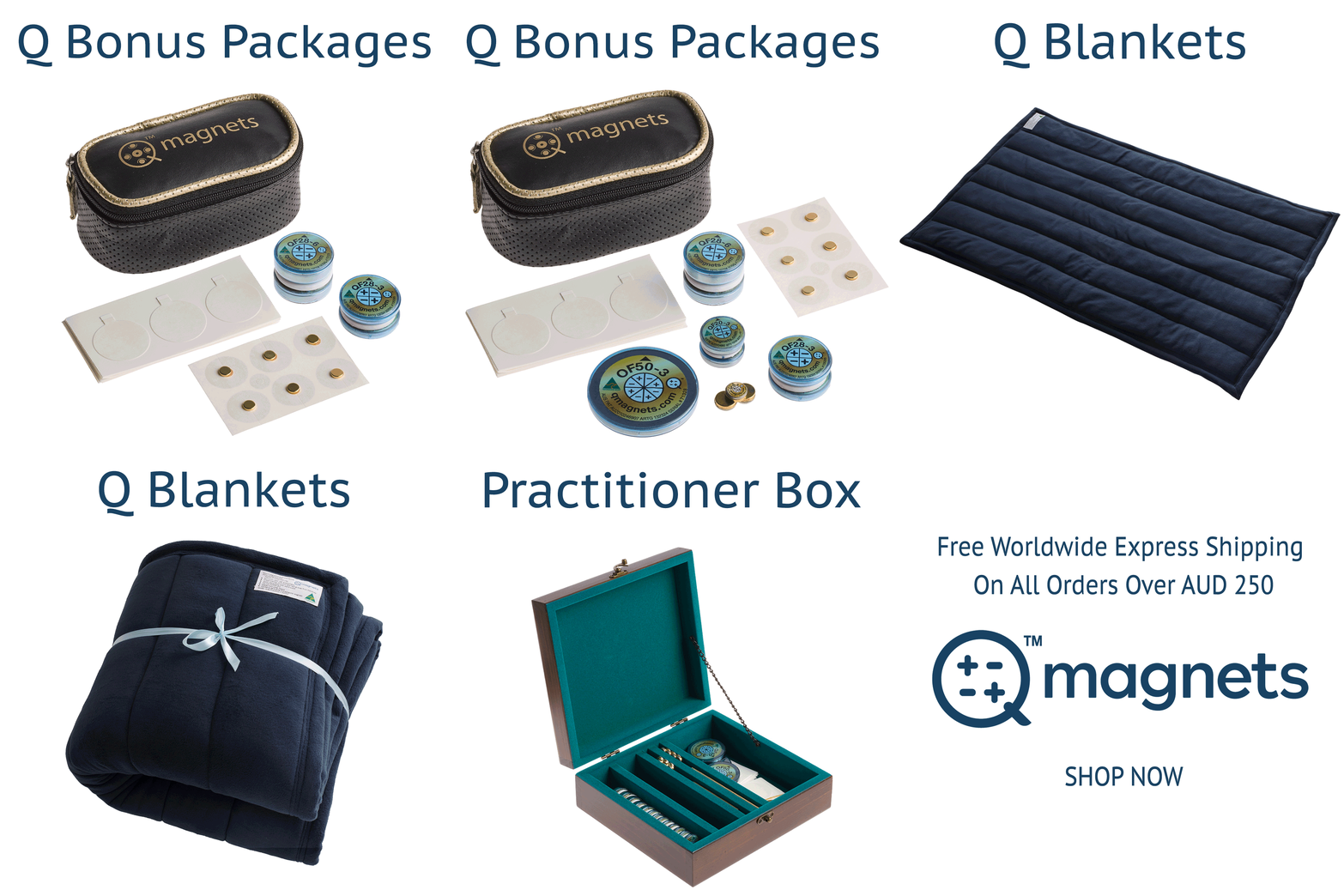
A Q Blanket is a magnetic blanket or mattress pad containing multiple Q Magnets sewn into a soft polar fleece pad. It is designed to provide a broader rest-time or sleep-time magnetic field environment, rather than the more targeted placement used with individual Q Magnets.
It can be used as a throw-over blanket, placed under part of the body, or used like a magnetic mattress pad.
How is a Q Blanket different from individual Q Magnets?
Individual Q Magnets are usually placed very specifically over a tender area, joint, nerve pathway, acupressure point, or other target area. Q Blankets are different because they provide broader coverage across a larger region of the body.
This makes the Q Blanket especially useful during rest, sleep, or recovery time, while individual Q Magnets may be better when a more precise placement is needed.
Can a Q Blanket cure chronic pain, back pain, hip pain, fibromyalgia, or sleep problems?
No. A Q Blanket should not be described as a cure.
Pain, poor sleep, fatigue, and chronic conditions can have many causes and should be assessed by a qualified health professional where appropriate. A better way to understand the Q Blanket is as a supportive tool that may help some people feel more comfortable, sleep more restfully, or manage discomfort as part of a broader care plan.
Why do people use a Q Blanket for sleep?
Many people choose a Q Blanket because it is easy to use during sleep or rest. Instead of taping individual magnets into position, the blanket can stay on the bed, couch, chair, or treatment table.
Customers often describe the benefits in simple terms: feeling more comfortable, waking with less stiffness or discomfort, feeling calmer, or getting a more restful night’s sleep.
Do I lie on the Q Blanket or place it over me?
Both methods can be used.
If you are using it like a mattress pad, lie on top of it. If you are using it as a throw-over blanket, drape it over the area you want to support. For lower back, hip, leg, or foot comfort, many people use it under the body during sleep or while resting.
Which way should the instruction label face?
For best field direction, the instruction label should face away from the body.
If the Q Blanket is used on a mattress, the instruction label should face down. If it is draped over the body, the instruction label should face up. This keeps the intended field side facing toward the body.
Which Q Blanket size should I choose?
Choose the size based on how much body coverage you want.
The Q13 is the smallest blanket and is often used for feet, knees, lower back, hips, or partial-body use. The Q28 and Q35 provide broader whole-body coverage. The Q20 is designed mainly for practitioner treatment couches or narrow treatment tables.
When is the Q13 a good choice?
The Q13 can be a good option for targeted rest-time use over a smaller region such as the lower back, hips, knees, feet, or upper torso. It may also suit people who want to start with a smaller blanket before investing in a larger model.
When should I consider the Q28 or Q35?
The Q28 and Q35 are better choices when you want wider body coverage. They may be more suitable for people with widespread discomfort, multiple areas of pain, persistent backache, general stiffness, or those who want a larger sleep-time magnetic field environment.
What is the Q20 Practitioner Blanket for?
The Q20 is designed for a long, narrow treatment couch or table. It may be useful for practitioners who want to include Q Blanket exposure during treatment sessions, or for home users who want a narrower pad for a bed, couch, or recovery area.
How long should I use the Q Blanket for?
Many people use a Q Blanket during sleep, while resting, or while sitting on a couch or chair. Some use it for shorter sessions, while others use it overnight.
Start with a comfortable amount of time and monitor how you feel. If you have a complex medical condition, unusual symptoms, or are unsure whether it is suitable for you, seek professional advice.
Can I sleep on the Q Blanket all night?
Yes, many people use a Q Blanket overnight. It is designed for rest-time and sleep-time use.
As with any support product, use common sense. If you feel uncomfortable, unusually restless, dizzy, or if symptoms worsen, stop using it and reassess.
Can I use the Q Blanket under sheets or bedding?
Yes. Static magnetic fields pass through most non-metallic materials, so a sheet or light bedding is usually not a problem.
Distance still matters. Very thick padding, heavy blankets, mattress toppers, or cushions may reduce the amount of field reaching the body. For best results, keep the Q Blanket reasonably close to the body while maintaining comfort.
Can I use the Q Blanket on a couch or chair?
Yes. Many people use the Q Blanket on a couch, chair, recliner, or recovery area. It can be placed underneath you, behind your back, over your legs, or wrapped around the lower back or hips.
This can be useful for people who want support while watching television, reading, resting, or recovering after activity.
Can I use individual Q Magnets as well as a Q Blanket?
Yes. A Q Blanket can be used as a broader rest-time support, while individual Q Magnets can be used for more targeted placement.
For example, someone may sleep on a Q Blanket and still use individual Q Magnets over a specific knee, shoulder, wrist, neck, back, or acupressure point. Follow the relevant instructions for each product.
Is the Q Blanket the same as a PEMF mat?
No. A Q Blanket is not a PEMF device.
PEMF devices use pulsed electromagnetic fields, usually powered by electricity. Q Blankets use static multipolar Q Magnets and do not plug in, pulse, vibrate, heat, or emit a frequency.
Does the Q Blanket have a frequency?
No. Q Blankets use static magnets, so they do not have a frequency.
Frequency requires a changing or pulsing field. Q Blankets are based on static multipolar magnetic fields from Q Magnets.
Can I use a Q Blanket if I have a pacemaker or implanted electronic device?
No. Q Blankets should not be used near a pacemaker, implanted defibrillator, magnetically programmable medical device, or other implanted electronic medical device unless cleared by the treating specialist.
Strong magnets can interfere with some medical devices, so this warning should be taken seriously.
Can I use a Q Blanket during pregnancy?
Q Blankets should not be used during pregnancy unless advised by a qualified health professional familiar with your situation.
This is a precaution because Q Blankets have not been specifically tested for pregnancy.
What if I have metal implants?
Many surgical implants are made from materials such as titanium, which usually has very little interaction with static magnetic fields. However, not all implants are the same.
If you have implanted hardware and are unsure what it is made from, check with your doctor or surgeon before using a Q Blanket, especially near the implant.
How do I wash and care for a Q Blanket?
Wash separately in warm water. Do not tumble dry.
Allow the Q Blanket to dry naturally and avoid exposing it to high heat. Do not iron directly over the magnets or leave the blanket in a hot car or near a heat source.
Can I feel the magnets when lying on the Q Blanket?
Most people find the blanket comfortable because the magnets are sewn into a padded polar fleece design. Some people may feel the magnet positions more than others depending on body weight, sleeping position, mattress firmness, and sensitivity.
If it feels uncomfortable, try using a thin sheet or adjusting the placement.
How quickly should I notice a result?
Responses vary. Some people report feeling a difference quickly, while others notice changes over days or weeks of regular use. Some people may not notice a meaningful effect.
A fair trial usually means using the Q Blanket consistently, checking that it is positioned correctly, and considering whether individual Q Magnets may be needed for more targeted support.
What should I do if I feel worse while using it?
Stop using the Q Blanket and allow symptoms to settle.
If you want to try again, check the orientation, placement, duration of use, and whether the blanket is appropriate for your situation. Do not continue using it if it clearly worsens symptoms. If pain is severe, unusual, worsening, or associated with numbness, weakness, swelling, fever, injury, or other concerning symptoms, seek medical advice.
Is the Q Blanket suitable for practitioners?
Yes. The Q20 Practitioner Blanket is designed for treatment couches, and other sizes may also be useful in clinic settings.
Practitioners may use Q Blankets as a rest-time or treatment-table support alongside more targeted Q Magnet placement. The best clinical use is to record the model, placement, duration, response, and any precautions.
Is the Q Blanket suitable for everyone?
No product is suitable for everyone.
Do not use a Q Blanket near pacemakers, implanted defibrillators, magnetically programmable devices, or during pregnancy unless medically advised. People with complex health conditions, unexplained symptoms, or implanted medical hardware should seek professional guidance before use.
What if I am unsure whether it will help me?
It is reasonable to be cautious, especially with chronic or complex conditions. Q Blankets do not work the same way for everyone.
The best approach is to choose the most suitable size for your goal, use it consistently, follow the instructions, and monitor changes in pain, sleep, comfort, movement, and daily function.