There is a lot more to magnets than the North and South pole contained in all common bipolar magnets. Where the strength of a magnetic field changes with distance there exists a field gradient which occurs equally at the North or South pole.
Magnetic materials are attracted to field gradients and NOT to a uniform or what physicists call a homogeneous field. This is well illustrated with the cow magnet. Cow magnets are used by cattle farmers to safely collect any metal objects such as nails or barbed wire their animal might ingest. Because the cow magnet produces a field gradient along the length of its shaft, metal objects will neatly stick to its sides. This is how it works…

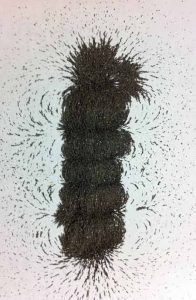
The magnets in the cow magnet are arranged so that each pole joins with the like pole of the adjoining magnet. This sets up a steep field gradient where the magnets are forced into position. Like poles repel so the cow magnet has to be assembled in a way that adjoining magnets are “forced” into place and secured there. The image above on the right shows iron filings sprinkled over the same cow magnet. The filings reveal where the like poles face each other.
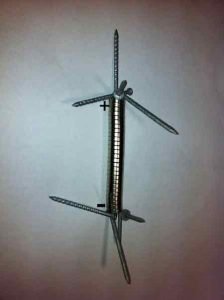
Along the length of a long bipolar magnet, there exists a strong field gradient only at the ends of the magnet. Along the shaft of the magnet the field is effectively uniform, hence there is no force of attraction between the magnet and nail along the shaft, the results of which can be seen in the image below. As you can imagine, this magnet would mean almost certain death to a cow, that’s why magnet design matters!
The same principle applies to magnetic design for therapeutic purposes. Cell and animal studies and controlled trials on humans show that different magnetic devices have different effects, see research on magnetic therapy. Neuromagnetics Australia is a world leader in the design and manufacture of magnet devices for therapeutic purposes, particularly for pain and injury recovery.
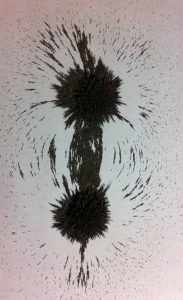
The image below to the right shows how iron filings are attracted to the ends of the magnet and along the shaft where the field is uniform the filings follow a straight line.
The design of Q Magnets for therapeutic effects is even more complicated as the research on cell studies undertaken by neurologists at Vanderbilt Medical University showed (Static Magnetic Fields for the Treatment of Pain); the active region of the magnet is where the field gradient is perpendicular to the local field vector. This can be seen with iron filings on a Q Magnet. See more about how magnets help with pain here.

Frequently Asked Questions
1. What makes Q Magnets different from other magnetic devices on the market today?
Q Magnets are different because they are not simple north-south bipolar magnets. They are precision-engineered multipolar medical magnets designed to create localized static magnetic field gradients.
Most generic magnetic products focus on magnet strength alone. Q Magnets are based on a more complete Field | Dose | Placement framework:
Field refers to the magnetic field geometry, including quadrupolar, hexapolar, octapolar, and other multipolar designs.
Dose includes magnet size, field strength, penetration depth, exposure time, and tissue depth.
Placement refers to the anatomical location, direction, and distance from the target tissue.
This is why Q Magnets should not be assessed only by gauss rating or pull force. The field shape, field gradient, and correct placement are central to how they are intended to be used.
Q Magnets are best understood as wearable field-based recovery technology rather than generic “wellness magnets.”
2. What is the “Sweet Spot” of a Q Magnet?
The “Sweet Spot” refers to the most important field interaction zone of the magnet. In Q Magnets, this is associated with the localized field gradients created at the boundaries between alternating magnetic poles.
This concept is closely related to Field | Dose | Placement. The field geometry creates the “sweet spot,” the size of the magnet influences the likely dose and tissue depth, and correct placement determines whether the target area is exposed to the intended part of the field.
Larger Q Magnets generally create a broader and deeper field environment. Smaller Q Magnets may be more suitable for superficial or precise applications, but they usually require more accurate placement because the effective area is smaller.
This is why the Body Map, Device Selection page, and product model information are important. The best choice is not always the strongest magnet; it is the magnet whose field, dose, and placement match the target area.
3. How do Q Magnets work?
Q Magnets are designed to create localized static magnetic field gradients using multipolar magnet geometry. Unlike simple bipolar magnets, Q Magnets use alternating poles within one device to produce a more complex field pattern.
The proposed biological effect is not based simply on magnet strength. Instead, Q Magnets are positioned through Field | Dose | Placement:
Field: multipolar geometry and localized gradients.
Dose: magnet size, field strength, tissue depth, exposure time, and cumulative use.
Placement: accurate positioning over or near the relevant nerve, joint, soft tissue, acupressure point, or referral pathway.
Research and theoretical work suggest that steep static magnetic field gradients may influence neuronal membrane excitability and ion channel behaviour. This may help explain why correct placement and model selection are so important.
Q Magnets should therefore be understood as precision field-based recovery tools rather than general-purpose magnets.