A Childhood Injury with Lasting Effects
Jude explains:
“I’m 68 and my health is good. I was a 13 year old doing a headstand when a boy decided he was going to pull my right arm out from me. I collapsed down from my head stand and spent three weeks in bed unable to move.”
The accident affected several areas of her body. Over the years she continued to experience:
- Recurring neck pain
- Lower back discomfort
- Sacral pain
- Hip instability
- Tendon pain
- Knee discomfort
She also continued receiving regular osteopathic care.
As Jude describes:
“My neck gets regular pain from the cervical. My vertebrae has been damaged from the fall as also lower back and sacral area.”
When Access to Treatment Changed
During lockdown, Jude suddenly found herself unable to visit her osteopath.
At around the same time, she developed benign paroxysmal positional vertigo (BPPV), a condition that commonly causes brief episodes of dizziness triggered by changes in head position.
BPPV has several recognised causes and is typically assessed and managed by appropriately trained healthcare professionals. Alongside this care, some people also look for additional non-invasive approaches that may help support comfort during recovery.
Jude chose to incorporate Q Magnets into her own routine.
She recalls:
“Recently because of my neck I have experienced BPPV and with the Lockdown unable to get osteopath treatment and successfully used the magnet for this.”
As with all testimonials, this reflects one person’s experience. Q Magnets are intended as a supportive, non-invasive option and are not a substitute for appropriate medical assessment or treatment.
The Q Magnets educational framework focuses on three interacting variables:
Field
Precision multipolar medical magnets create localized static magnetic field gradients through engineered polarity arrangements.
Dose
Magnet size, exposure duration, tissue depth and cumulative wear time may all influence the field environment experienced by superficial tissues.
Placement
Accurate anatomical positioning is important. Correct placement aims to bring localized static magnetic field gradients closer to the tissues or sensitized structures being targeted.
Together, Field | Dose | Placement helps explain why different body regions may require different magnet sizes and placements rather than a one-size-fits-all approach.
A Practical Recovery Routine
Rather than relying on a single application, Jude developed a routine that addressed different areas depending on her symptoms.
She explains:
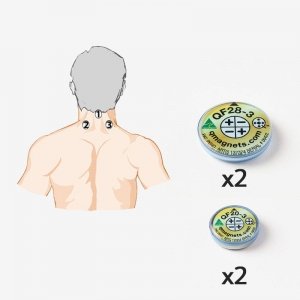
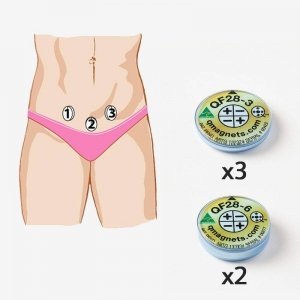
“I use the Q Magnets a few days a week on the neck shoulder area, lower back sacral, fingers for tendon pain, knee, hip flexor and toes.”
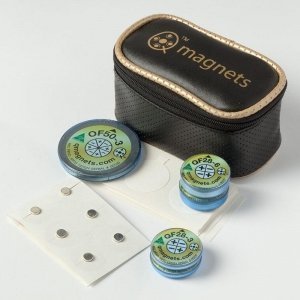
She also selected different Q Magnet models for different parts of her body:
This reflects an important principle of static field therapy. Different anatomical structures may benefit from different magnet sizes and field characteristics. Matching the field to the target tissue forms part of the Q Magnets Field | Dose | Placement philosophy, recognising that anatomy, tissue depth and recovery goals vary from person to person.
Supporting Recovery with Static Field Therapy
When Everyday Life Becomes Easier
Sometimes the biggest changes are not measured by a pain score but by simply getting on with life.
Jude explains:
“I lose track of the time as I all of a sudden realise that I am no longer in pain.”
Whether gardening, walking or spending time with family, becoming less focused on discomfort and more engaged in everyday activities is often an important part of recovery.
Why People Explore Magnetic Therapy for Neck and Lower Back Pain
People searching for magnetic therapy for neck pain or lower back pain are often looking for options that are:
- Non-invasive
- Reusable
- Compatible with active lifestyles
- Suitable for prolonged wear
- Able to complement existing healthcare
Q Magnets are designed as precision multipolar medical magnets that create localized static magnetic field gradients over superficial tissues. Their application is guided by the principles of Field | Dose | Placement, recognising that magnet selection, anatomical positioning and exposure duration may all contribute to the overall field environment.
This systems-based approach helps distinguish Q Magnets from generic magnetic products while aligning static field therapy with modern concepts in recovery physiology and nervous system modulation.
Read our complete guide to magnetic therapy for pain conditions
Learn about medical magnets for low back pain
Jude’s Final Thoughts
After decades of managing the effects of a childhood injury, Jude found a practical recovery tool that fitted into her everyday life.
She concludes:
“The thing I love most about my Q Magnets is the ease to use and the new pain free quality of life!!”
And when asked whether she would recommend them:
“I would absolutely recommend Q Magnets!”
Jude’s experience represents one person’s journey, but it highlights an important principle behind the Q Magnets approach. Recovery is rarely the result of a single intervention. Instead, it often involves combining appropriate healthcare, movement, education and carefully applied recovery technologies to help support long-term comfort, function and quality of life.