Pain begins with electrical signals travelling through the nervous system. The real question is not simply whether magnetic therapy works, but whether a static magnetic field can influence how those signals are generated or transmitted.
Current research suggests that, under certain conditions, static magnetic fields may influence nerve activity. However, results are not uniform and depend greatly on how the field is applied.
What the Research Suggests
Static magnetic fields have been studied for their potential to influence pain-related nerve activity. The evidence does not support simplistic explanations, but it does suggest that magnetic fields may affect biological systems in specific and measurable ways.
Rather than producing the same result every time, magnetic field therapy appears to depend on whether the field is applied within an effective range of conditions. This helps explain why some people report meaningful pain relief while others notice little or no change.
Why Magnetic Therapy Results Vary
Magnetic therapy is often discussed as though it should either work for everyone or not work at all. Biological systems do not behave that way.
Outcomes depend on several interacting factors, especially:
- field strength and structure
- duration of exposure
- placement relative to the target tissue
These factors determine whether the magnetic field interacts meaningfully with the biological system.
Field | Dose | Placement
A practical way to understand magnetic therapy is through three key variables: field, dose, and placement.
Field (Strength and Structure)
Field refers to the strength and configuration of the magnetic field, including its gradient. The field must be sufficient to reach and interact with the target tissue. In many cases, field structure matters as much as field strength.
Dose (Duration of Exposure)
Dose refers to how long the magnetic field is applied. Static magnetic fields do not deliver energy into tissue in the way that some other therapies do. Their effects may depend on continuous exposure over time rather than short treatment sessions.
Placement (Location Relative to Tissue)
Placement determines whether the field interacts with the relevant nerve pathways or affected structures. Even a well-designed magnet may have little effect if it is not positioned correctly.
How Static Magnetic Fields May Influence Nerve Activity
Nerve cells communicate using electrical impulses called action potentials. These depend on the movement of ions such as sodium and calcium through specialised channels in the cell membrane.
Changes in ion channel behaviour can alter nerve excitability. This has led researchers to examine whether static magnetic fields may affect the membrane environment in a way that influences how easily nerves fire.
The working theory can be summarised as follows:
- Some pain-related nerves may fire more easily than normal.
- This may involve altered ion channel behaviour.
- A static magnetic field may influence the local membrane environment.
- This may help stabilise abnormal nerve firing.
- Reduced abnormal signalling may lead to reduced pain perception.
This explanation reflects modulation of biological conditions rather than direct force or energy transfer.
For a broader explanation of how magnetic therapy works, see the science behind magnetic pain relief.
Some common claims about magnetic therapy, such as magnets attracting iron in the blood, are incorrect and do not reflect current scientific understanding. A more plausible line of investigation is whether static magnetic fields may influence ion chann]els, membrane behaviour, or nerve excitability under certain conditions.
For further background, see How Q Magnets Work.
Evidence from Experimental Studies
Experimental research has shown that static magnetic fields can influence nerve activity under certain conditions.
Studies involving sensory neurons exposed to quadrapolar magnetic fields have demonstrated:
- reduced action potential activity
- effects occurring at specific distances from the magnet
- reversibility after removal of the field
These findings suggest a functional effect on nerve signalling rather than structural damage.
Published Research on Action Potential Blockade
The image below shows experimental results from a published study investigating action potential blockade under the influence of the magnetic field from a quadrapolar magnet. Each trace shows activity recorded from the same neuron at different times. You can also see a video of the researchers conducting the experiment here.
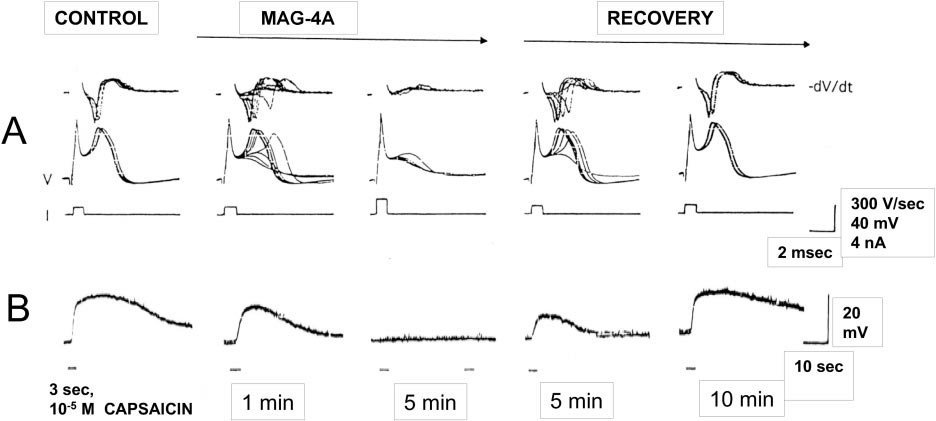
Action potential blockade at the maximally effective region (MER) of a quadrapolar magnet, 5 mm from the surface. Adapted from McLean et al. (2001), Reference 2.
What the Hashemi and Abdolali Study Examined
A study by Hashemi and Abdolali used three-dimensional modelling to evaluate how static magnetic fields may affect neurons.
Their work compared several proposed mechanisms and assessed whether they could realistically occur within the strength range of typical magnets. This helped clarify which explanations are more plausible in biological systems and which are less likely.
Four Proposed Mechanisms
1. Force on Moving Charged Particles
Magnetic fields can exert force on moving ions such as sodium and calcium. However, in biological systems, electrical forces across the membrane are significantly stronger than magnetic forces produced by typical static magnets. This makes this mechanism less likely to explain observed effects.
2. Effects on Ion Channels
Ion channels are protein structures within the cell membrane that regulate ion movement. It has been proposed that static magnetic fields may influence these structures and alter how they function. This provides a more plausible link to changes in nerve excitability.
3. Effects on Paramagnetic and Diamagnetic Ions
Some ions respond to magnetic fields according to their magnetic properties. This has led to the suggestion that magnetic field gradients, rather than uniform fields, may play a more important role in biological effects.
4. Torque Effects on Membrane Structures
Another proposed mechanism involves rotational forces acting on diamagnetic components within the cell membrane. This mechanism is considered more plausible because it may operate within realistic magnetic field strengths and aligns more closely with experimental observations.
An example for the physics-minded reader:
The first mechanism is related to magnetophoresis, which means motion induced on a particle while under the influence of a magnetic field. If a sodium ion moves through a cell membrane, it experiences what is called a Lorentz force:
F = qE + qvB
In this equation, F is force, q is electric charge, E is the electric field, v is the particle velocity, and B is the magnetic field. In practice, the naturally occurring electric forces across the membrane are vastly stronger than the magnetic forces produced by ordinary static magnets.
That means this mechanism is useful to examine, but on its own it may not be the best explanation for how static magnetic fields affect neurons in biological settings.

Formula proposed by Hashemi and Abdolali for calculating the magnetic force on a nerve membrane.
Why Magnetic Field Gradients Matter
Magnetic fields used in biological applications are not uniform. Gradients within the field can create localised effects that differ from a simple steady field.
This is important because biological interaction may be more likely in regions where the field changes across space, rather than in areas where it remains constant. This helps explain why magnet design and placement both matter.
For more on this, see Magnetic Field Gradients.

Experimental setup used to simulate neuron exposure under a quadrapolar coil magnet.
Findings from Earlier Research
Earlier studies examining neuron behaviour under static magnetic fields found:
- effects were strongest after approximately 200 to 250 seconds
- a reduction in the rate of nerve firing
- no significant change in resting membrane properties
These findings suggest that static magnetic fields may influence nerve excitability rather than altering the structure of the nerve itself.
Across multiple studies, researchers have proposed that these effects may involve changes in membrane permeability to sodium and calcium ions.
For a broader research overview, see Scientific Evidence for Magnetic Field Therapy.
What This Means in Practical Terms
Not all proposed mechanisms are equally likely.
Some would require magnetic field strengths far beyond what typical static magnets can produce. Others, particularly those involving membrane-level interactions and field gradients, are more consistent with both experimental findings and realistic field strengths.
This helps explain why results can vary and why application method matters.
Do Static Magnets Help With Pain?
The most accurate answer is that static magnets may help with pain under certain conditions.
This does not mean they work in all cases, nor does it support exaggerated claims. What the evidence suggests is that static magnetic fields may influence pain signalling when the field is applied in a way that effectively interacts with the relevant biological systems.
Why Some People Experience Results
Differences in outcome can often be explained by variation in:
- field strength and structure
- duration of exposure
- placement relative to target tissue
If these factors are not aligned, the field may not interact effectively with the system. If they are aligned appropriately, the chances of producing a meaningful biological response may be higher.
Conclusion
Current research does not support simplistic explanations of magnetic therapy. However, it does support continued investigation into how static magnetic fields may influence nerve activity under specific conditions.
The most plausible explanations involve interactions at the level of the cell membrane and ion channels, particularly in regions where magnetic field gradients are present.
A more accurate way to assess magnetic therapy is not simply to ask whether magnets work, but to ask under what conditions they may work, and why.
If you would like to explore the broader theory behind Q Magnets, visit How Q Magnets Work or review the wider literature on Scientific Evidence for Magnetic Field Therapy.
References
Hashemi, S., & Abdolali, A. (2017). Three-dimensional analysis, modeling, and simulation of the effect of static magnetic fields on neurons. Bioelectromagnetics, 38(2), 128-136. PMID: 27862074. DOI: 10.1002/bem.22019
McLean, M., Engstrom, S., Holcomb, R. R., & Sanchez, D. (2001). Static magnetic fields for the treatment of pain. Epilepsy & Behavior, 2(3 Suppl), S74-S80. DOI: 10.1006/ebeh.2001.0211
McLean, M. J., Holcomb, R. R., Wamil, A. W., Pickett, J. D., & Cavopol, A. V. (1995). Blockade of sensory neuron action potentials by a static magnetic field in the 10 mT range. Bioelectromagnetics, 16(1), 20-32. PMID: 7748200. DOI: 10.1002/bem.2250160108
Cavopol, A. V., Wamil, A. W., Holcomb, R. R., & McLean, M. J. (1995). Measurement and analysis of static magnetic fields that block action potentials in cultured neurons. Bioelectromagnetics, 16(3), 197-206. PMID: 7677796. DOI: 10.1002/bem.2250160308
About the Author
Frequently Asked Questions
1. Do Q Magnet devices mask pain?
Q Magnets are not intended to numb an area like a local anaesthetic. They do not work like lidocaine, opioid medication, or pain-relieving drugs that temporarily block or override pain perception.
Their proposed role is more closely related to nervous system modulation. Laboratory and theoretical work suggests that steep static magnetic field gradients may influence nerve excitability and membrane behaviour, especially where sensitized nerves are involved.
A Roth-proof way to explain this is: Q Magnets may help create a localized field environment that supports reversible neuromodulation. They are not designed to “switch nerves off” permanently or hide an injury that needs medical care.
If pain is severe, worsening, unexplained, or associated with injury, swelling, weakness, numbness, fever, or other concerning symptoms, seek appropriate medical advice.
2. What is the mechanism of action?
The precise biological mechanism of Q Magnets has not been fully established. The current scientific positioning is that engineered multipolar static magnetic field gradients may influence membrane excitability, ion movement, and sensitized nerve signalling.
The proposed mechanism focuses on the interaction between steep localized field gradients and nerve cell behaviour. This may involve changes in sodium and calcium ion dynamics, membrane permeability, resting membrane potential, and action potential firing patterns.
Q Magnets may support reversible neuromodulation by creating localized static magnetic field environments. This is also why Field | Dose | Placement is central. The field must be appropriately engineered, the dose must match tissue depth and exposure needs, and the placement must align with the target anatomy.
3. How do Q Magnets work?
Q Magnets are designed to create localized static magnetic field gradients using multipolar magnet geometry. Unlike simple bipolar magnets, Q Magnets use alternating poles within one device to produce a more complex field pattern.
The proposed biological effect is not based simply on magnet strength. Instead, Q Magnets are positioned through Field | Dose | Placement:
Field refers to multipolar geometry and localized gradients.
Dose refers to magnet size, field strength, tissue depth, exposure time, and cumulative use.
Placement refers to accurate positioning over or near the relevant nerve, joint, soft tissue, acupressure point, or referral pathway.
Research and theoretical work suggest that steep static magnetic field gradients may influence neuronal membrane excitability and ion channel behaviour. This may help explain why correct placement and model selection are so important.
Q Magnets should therefore be understood as precision field-based recovery tools rather than general-purpose magnets.
4. What is an Action Potential?
An action potential is the electrical signalling event used by nerves to transmit information, including pain-related signals, through the nervous system.
A nerve cell has a resting membrane potential, which is influenced by ions such as sodium, calcium, potassium, and chloride moving across the cell membrane. When the nerve reaches a certain threshold, an action potential can occur and the signal travels along the nerve fibre.
In the Q Magnets framework, the relevance of action potentials is that steep static magnetic field gradients are proposed to influence membrane excitability and ion dynamics. This may help explain the concept of reversible neuromodulation, especially where nerves have become sensitized.
This does not mean Q Magnets forcibly stop all nerve signals. A more careful explanation is that they may influence the local field environment around sensitized nerve structures in a way that supports altered signalling behaviour.