Under the Field | Dose | Placement (FDP) principle, these additional placements should be selected according to the individual’s pain distribution, tenderness, movement restriction and other relevant symptoms rather than routinely applying every point listed. The objective is to match the magnetic field and dose to the anatomical structure being targeted.
TMJ and jaw pain may involve more than the joint itself. The uploaded Adjunct Placement reference identifies acupuncture points around the jaw and ear, a distal hand point, and trigger points involving the muscles of mastication as well as muscles of the neck and shoulder.
Recommended Additional Placements
Acupuncture Points
1. ST6
ST6 corresponds closely with the masseter region and is particularly relevant where there is tenderness or muscular involvement around the side of the jaw. The Adjunct Placement reference also identifies the masseter trigger point with ST6, illustrating the anatomical overlap that can occur between acupuncture and myofascial approaches.
2. ST7
ST7 is an additional local point around the TMJ and upper jaw region. It may be considered where symptoms are concentrated close to the joint or adjacent muscles involved in jaw movement.
3. LI4
LI4 is a distal acupuncture point on the hand. It provides an option away from the painful jaw region and may be considered as an adjunct when a distal acupuncture placement is appropriate.
4. SI19
SI19 is located in the region immediately adjacent to the ear and TMJ. It may be considered when symptoms are concentrated around the joint and pre-auricular region.
Myofascial Trigger Points
5. Masseter
The masseter is one of the major muscles involved in closing the jaw and lies over the side of the mandible. Tenderness within the masseter may be particularly relevant where jaw pain is associated with chewing, muscular tension or local sensitivity.
The Adjunct Placement reference specifically correlates the masseter trigger-point region with ST6.
6. Temporalis
The temporalis is a broad muscle over the side of the head above the ear. It contributes to jaw closing and may be relevant when jaw symptoms are accompanied by temporal tenderness or head pain.
7. Lateral Pterygoid
The lateral pterygoid is a deeper muscle associated with movement of the jaw and the TMJ. Because it is a deeper structure and is not as easily located from the surface as the masseter or temporalis, accurate localisation is particularly important.
8. Sternocleidomastoid (SCM)
The sternocleidomastoid extends along the side of the neck between the region behind the ear and the upper chest. It may be considered where jaw symptoms occur alongside neck tenderness or muscular involvement.
9. Upper Trapezius
The upper trapezius extends across the upper shoulder and into the neck. It may be relevant where TMJ or jaw symptoms occur together with upper-neck or shoulder tenderness.
The inclusion of the SCM and upper trapezius in the TMJ / Jaw Pain Adjunct Placement reference reinforces the principle of looking beyond the painful joint when associated muscular regions appear to be contributing to the individual’s symptoms.
Where These Points Are Located
For practical localisation, the adjunct points can be considered in three anatomical groups:
Around the jaw and TMJ
- ST6 – masseter region along the side of the jaw.
- ST7 – local region around the upper jaw and TMJ.
- SI19 – immediately adjacent to the ear and TMJ.
- Masseter trigger point – within the main muscle belly over the side of the jaw.
- Lateral pterygoid – a deeper muscle associated with the TMJ and jaw movement.
Around the head and neck
- Temporalis trigger point – within the broad temporal muscle above and forward of the ear.
- SCM trigger point – along the prominent muscle running down the side of the neck.
- Upper trapezius trigger point – within the upper shoulder and lower-neck region.
Distal placement
- LI4 – on the hand, away from the primary jaw region.
The TMJ itself can be identified by placing a finger immediately in front of the ear while opening and closing the mouth. This remains part of the Primary Placement described in the Treatment Protocol rather than an Adjunct Placement.
[Insert Image Here]
Image Suggestion
Create a medical-style anatomical illustration of the lateral head, jaw, neck and upper shoulder, with a smaller inset illustration of the hand.
Use numbered markers corresponding directly with the written placements:
- ST6 – mark over the masseter region.
- ST7 – mark adjacent to the TMJ/upper jaw region.
- LI4 – show separately in an inset diagram of the hand.
- SI19 – mark immediately adjacent to the ear/TMJ region.
- Masseter trigger point – label the masseter muscle and indicate the trigger-point region.
- Temporalis trigger point – label the temporalis muscle and indicate the relevant region.
- Lateral pterygoid – show the deeper muscle in a cut-away or inset illustration so its relationship to the TMJ can be understood without suggesting that it is a superficial structure.
- Sternocleidomastoid trigger point – label the SCM along the side of the neck.
- Upper trapezius trigger point – label the upper trapezius across the upper shoulder and lower neck.
Also label:
- Temporomandibular joint
- Mandible
- Temporal bone
- External ear
- Masseter
- Temporalis
- Lateral pterygoid
- Sternocleidomastoid
- Upper trapezius
The TMJ should be visually distinguished as the Primary Placement region, while the numbered acupuncture and trigger-point locations should be clearly identified as optional Adjunct Placements.
The educational purpose of the illustration is to show how local jaw structures, deeper muscles and associated neck and shoulder muscles may all form part of the wider anatomical picture without implying that every point should be treated.
Image Caption
TMJ / Jaw Pain Adjunct Placements: The Primary Placement over the TMJ remains the recommended starting point. Numbered acupuncture and trigger-point locations show optional additional placements that may be selected according to the individual’s symptoms, tenderness and movement restriction.
Recommended Magnets
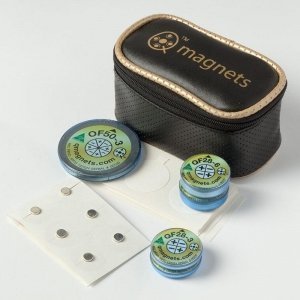
Magnet selection should follow the Field | Dose | Placement principle. The category reflects magnet size, profile, field depth and anatomical coverage rather than simply magnet diameter or strength. Small magnets are generally used for superficial or discrete acupuncture points, medium magnets for superficial-to-medium structures, and larger magnets for deeper focal structures or larger trigger-point regions.
Acupuncture Points
ST6 – Medium Quadrapolar or Hexapolar – M
ST6 is assigned M in the Adjunct Placement reference. A medium multipolar magnet provides appropriate coverage for the local jaw region while remaining more targeted than a larger trigger-point placement.
ST7 – Medium Quadrapolar or Hexapolar – M
ST7 is assigned M. Its location around the TMJ and upper jaw region suits a medium magnet where sufficient local anatomical coverage is required.
LI4 – Small Quadrapolar – S
LI4 is assigned S. As a discrete superficial acupuncture point on the hand, a small Quadrapolar magnet provides more precise localisation.
SI19 – Medium Quadrapolar or Hexapolar – M
SI19 is assigned M. A medium magnet provides coverage appropriate to the region immediately adjacent to the TMJ and ear.
Trigger Points
Masseter – Large Quadrapolar or Hexapolar – L
The masseter is assigned L. The larger category is appropriate where the objective is to cover a focal region within this substantial jaw muscle rather than only the smaller ST6 acupuncture-point location.
This distinction is important: ST6 is M, while the masseter trigger-point placement at the same general anatomical region is L, because the target and required anatomical coverage differ.
Temporalis – Medium Quadrapolar or Hexapolar – M
The temporalis is assigned M. This provides a more localised field for the temporal muscle region without unnecessarily increasing the dose.
Lateral Pterygoid – Large Quadrapolar or Hexapolar – L
The lateral pterygoid is assigned L. The larger magnet category reflects the deeper anatomical target. Because this muscle is not as readily localised from the surface, accurate positioning is particularly important.
Sternocleidomastoid (SCM) – Large Quadrapolar or Hexapolar – L
The SCM is assigned L, providing broader coverage appropriate to a focal trigger-point region within this larger neck muscle.
Upper Trapezius – Large Quadrapolar or Hexapolar – L
The upper trapezius is assigned L, consistent with its larger muscle mass and the broader coverage typically required for a trigger-point placement.
These assignments follow the TMJ / Jaw Pain recommendations and the magnet-category definitions in the Adjunct Placement reference.
Practical Placement Guidance
Begin with the Primary Placement in the TMJ Pain Treatment Protocol. Adjunct Placements should then be considered selectively rather than applying every listed point at once.
Where practical, gently palpate the relevant jaw, temporal, neck and shoulder regions for areas of tenderness or sensitivity. Begin with the additional location or locations that most closely correspond with the individual’s symptoms.
For example:
- Predominantly local jaw or chewing-related tenderness may direct attention towards ST6, ST7, SI19 or the masseter.
- Temporal tenderness may make the temporalis more relevant.
- Deeper symptoms associated with jaw movement may warrant consideration of the lateral pterygoid region, preferably with professional assistance where accurate localisation is uncertain.
- Accompanying neck or shoulder tenderness may make the SCM or upper trapezius more relevant.
- LI4 provides a distal acupuncture-point option when an additional placement away from the jaw is considered appropriate.
The Primary Placement protocol identifies the TMJ immediately in front of the ear as an important access region and also describes an occipital placement at the base of the skull covering C1. These remain part of the Primary Placement strategy and should not be replaced simply because additional acupuncture or trigger-point locations are being used.
When using multiple Q Magnets, adequate separation between devices is important to minimise unwanted magnetic-field interference. Placement should remain anatomically purposeful rather than attempting to cover every possible location.
If an Adjunct Placement is being added because the initial placement has not provided sufficient support, reconsider Field, Dose and Placement rather than simply adding progressively more magnets. The magnet category should match the depth and anatomical coverage of the intended target.
Not every Adjunct Placement will be appropriate for every person. Select additional points according to the individual’s pain distribution, local tenderness, movement restriction and associated jaw, head, neck or shoulder symptoms.
TMJ and facial pain can have different causes. The Treatment Protocol notes that jaw pain may occur with TMJ disorders and may also be associated with other conditions, including trigeminal neuralgia. Persistent or unexplained symptoms therefore warrant appropriate professional assessment rather than assuming that all facial or jaw pain originates from the TMJ.
If pain is severe, persistent, unexplained, changing significantly, or accompanied by other concerning symptoms, seek assessment from an appropriately qualified healthcare professional.
These placements are provided as a conservative educational guide. Accurate placement remains important, particularly for deeper structures or when the source of the symptoms is uncertain.